On This DayWong Kar-wai’s In the Mood for Love opens in Hong Kong in 2000 – from the SCMP archive
On September 29, 2000, the Hong Kong director’s celebrated cinematic love story was screened in theatres across the city for the first time

This article was first published on September 29, 2000
By Fionnuala Halligan
In the mood for nostalgia
With his latest movie In the Mood for Love, Shanghai-born Wong Kar-wai takes a trip back to his own childhood – and a Hong Kong which, he believes, has long vanished. He moved here with his parents when he was five and his recollections of the two-faced nature of adults – their ability to deceive each other and keep up pretences – inspired his latest film. “I would always see my uncle and aunts looking very decent,” recalls Wong. “But then I would hear my parents gossiping about them.”
In the Mood for Love, which won the Grand Technical Prize at Cannes this year (2000) as well as best actor for Tony Leung Chiu-wai, is about next-door neighbours in Hong Kong in 1962 whose spouses are having an affair. So the dejected pair, played by Leung and Maggie Cheung, embark upon one of their own.
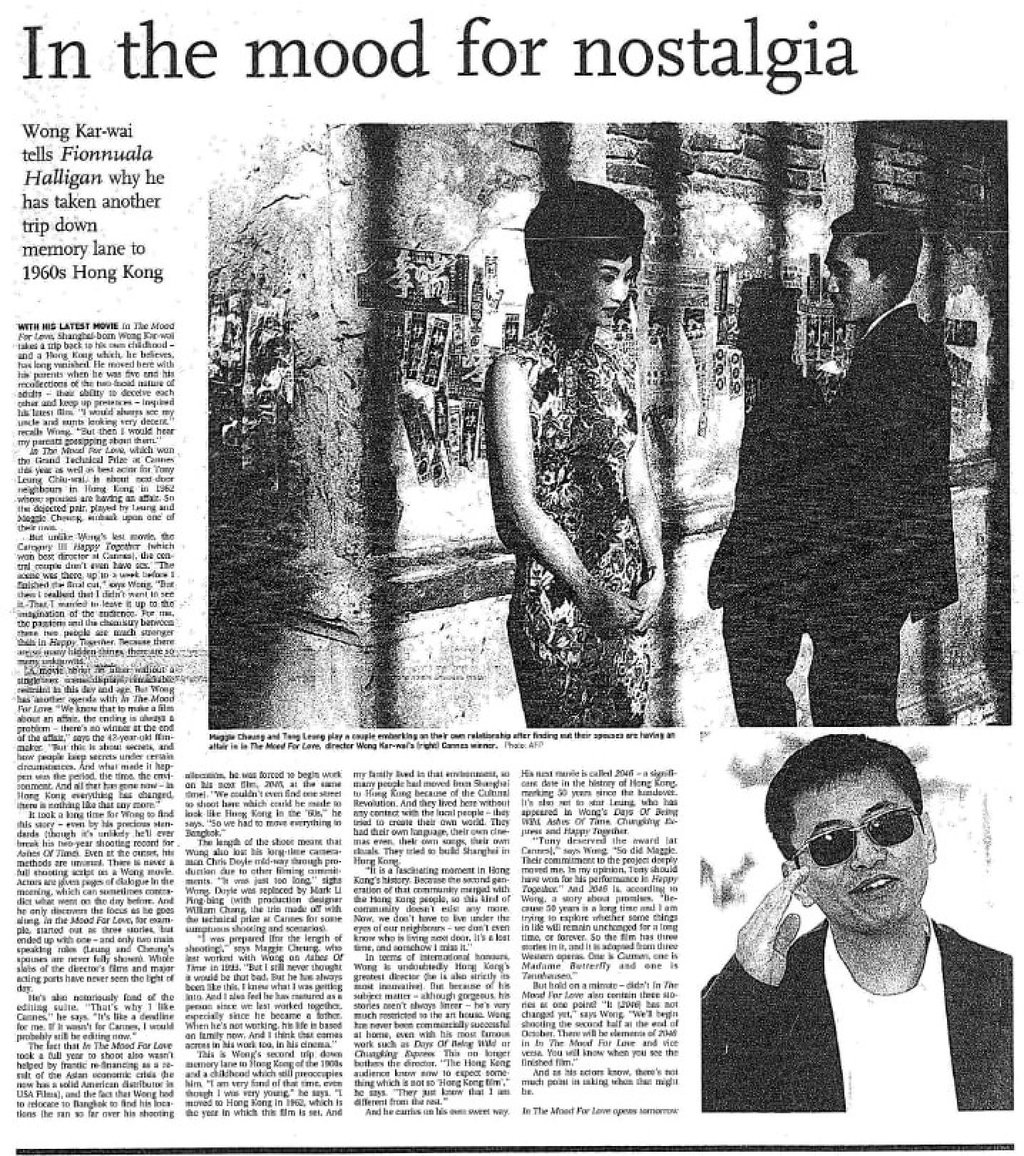
But unlike Wong’s last movie, the Category III Happy Together (which won best director at Cannes), the central couple don’t even have sex. “The scene was there, up to a week before I finished the final cut,” says Wong. “But then I realised that I didn’t want to see it. That I wanted to leave it up to the imagination of the audience. For me, the passions and the chemistry between these two people are much stronger than in Happy Together. Because there are so many hidden things, there are so many unknowns.”
A movie about an affair without a single sex scene displays remarkable restraint in this day and age. But Wong has another agenda with In the Mood for Love. “We know that to make a film about an affair, the ending is always a problem – there’s no winner at the end of the affair,” says the 42-year-old filmmaker. “But this is about secrets, and how people keep secrets under certain circumstances. And what made it happen was the period, the time, the environment. And all that has gone now – in Hong Kong everything has changed, there is nothing like that any more.”