Advertisement
Xinjiang
EconomyChina Economy

How is Xinjiang’s economy holding amid US sanctions, and can China keep supporting its ‘great burden’?

  • The US earlier this year banned cotton and tomato products from Xinjiang over alleged human rights violations and the widespread use of forced labour in the region
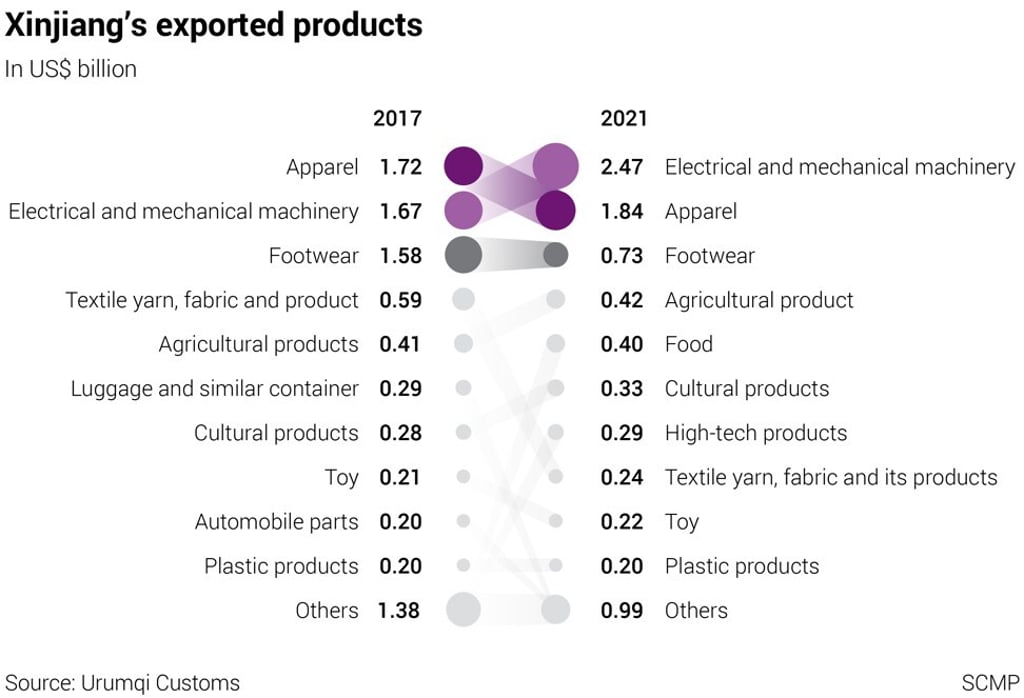
  • Xinjiang remains a major agricultural base, although unlike coastal provinces, its economy does not heavily rely on exports

7-MIN READ7-MIN
25
Xinjiang remains a major agricultural base and primary industries that harvest or extract raw materials still accounted for 14.4 per cent of gross domestic product (GDP) in 2020. Illustration: Henry Wong
Cissy Zhou

This is the first in a series of stories looking at China’s Xinjiang province and how the far-western region is coping economically under a series of US sanctions over alleged human rights violations and the widespread use of forced labour.

Nine months ago, when the United States banned cotton and tomato products from Xinjiang over alleged human rights violations and the widespread use of forced labour in the region, cotton farmers in particular in the far-west region feared the worst.
Advertisement

But with the unprecedented coronavirus stimulus packages around the world spurring consumption and increasing demand for cotton, a key material in garments and other textile products, the fallout has not been as bad as first feared.

At the same time, the region’s revenue is heavily dependent on the central government, with Beijing required to pour large amounts of money into the region.

The region is seen as being more important for “national and territorial security” rather than for it to become a “very strong economic province”, according to Gu Xuewu, the director of the Centre for Global Studies at the University of Bonn in Germany.
SCMP
SCMP
This means Beijing still needs to support Xinjiang with money and resources, and is it unclear if this is a sustainable economic model, even if it has been able to benefit from a coronavirus-induced shift in production away from major cotton and textile producers in Southeast Asia and India, increasing demand for Xinjiang cotton
Advertisement

In the first seven months of 2021, China’s exports of home textiles – including rugs, bedsheets and curtains – reached US18.44 billion, up 44.8 per cent year on year.

Xinjiang’s annual output of cotton is around 5 million tonnes, accounting for 87.3 per cent of the country’s total cotton production last year.

A survey in July of more than 90 textile manufacturers across the country by the China Cotton Association showed that factories are slightly reducing their reliance of Xinjiang cotton, increasing the use of imported products, but it still accounted for 86.7 per cent of the total cotton consumption across the country, compared to 9.8 per cent for imported.

SCMP Series
[ 1 of 6 ]
Select Voice
Select Speed
1.00x