Once considered utilitarian, titanium is now the material of choice for elegant pieces like the Santos de Cartier and Bulgari Octo Finissimo
Historically, titanium has been prized in watchmaking for its strength, corrosion resistance and extraordinary lightness – ever since its debut with Citizen’s X-8 Chronometer in 1970, followed a decade later by IWC’s collaboration with Porsche Design. For decades, the material was considered utilitarian, favoured for dive watches, chronographs and other performance-driven designs thanks to its ability to endure extremes. Today, however, that perception is evolving as brands experiment with its potential for elegance.
“The increasing use of titanium in refined pieces from brands like Cartier, Bulgari and Grand Seiko indeed signals a paradigm shift in how we define a dress watch,” says Jackie Ho, collector and founder of Watch Ho & Co. “As the industry moves towards more versatile timepieces, titanium’s unique blend of durability, lightness and style makes it an attractive material for modern collectors seeking both form and function. This shift is driven by the evolving tastes of collectors, who crave watches that can seamlessly transition from formal to casual settings, without compromising on style or performance.”
This evolution reflects a broader blurring of boundaries within watch design. The days of strict category divisions – tool, dress, sport – are giving way to a more fluid understanding of versatility. In an age when collectors want watches that fit every facet of their lives, titanium has become the perfect medium: practical yet elevated.
Advertisement
Sebastian Stan wearing the Santos de Cartier in titanium. Photo: Handout
Cartier’s decision to construct the Santos de Cartier LM Titanium entirely from the material (with the exception of the stainless-steel clasp) is telling. The metal isn’t new to the maison – it’s appeared in jewellery, in components alongside other metals, and occasionally in the bezels of sportier Santos models – but never before in such a complete, elevated form. The 2025 Santos, with a bead-blasted matte finish offset by polished bevels and screws, takes what could easily feel industrial and renders it understated, tactile and distinctly Cartier.
The Santos has always been the maison’s most experimental platform. Since the 1970s, it has embodied the brand’s ability to merge jewellery design with sportiness, from the integrated steel bracelet introduced in 1978 to more avant-garde skeletonised versions in recent years. The titanium Santos continues that lineage, embracing a material that has become emblematic of modern luxury – one defined as much by comfort and innovation as by traditional polish. “Cartier’s bold move to construct the Santos entirely from titanium showcases the brand’s unwavering commitment to innovative design and technical prowess,” comments Ho.
Still, titanium’s ascent into the dress category has been met with a certain amount of scepticism. As Chris Hall, former editor of Mr Porter watch magazine The Journal, notes: “The recent use of titanium in refined pieces from brands like Cartier and Grand Seiko [could signal] a permanent shift in how we define a ‘dress watch’. Grand Seiko’s strength in titanium watchmaking is well established but it is less of a bellwether brand in terms of dress-watch trends. Certainly a titanium Cartier could feel like a turning point. Whether I’d call it a permanent shift, I’m not sure. As we have seen across watch design, it’s probably more reasonable to talk about a relaxation of strict category rules.”
Indeed, rather than signalling the demise of traditional luxury materials, titanium’s emergence may represent an expansion of choice. “I’d be surprised if there was a real pivot away from precious metals, but what’s significant is these brands sense that they need to offer the choice,” notes Hall.
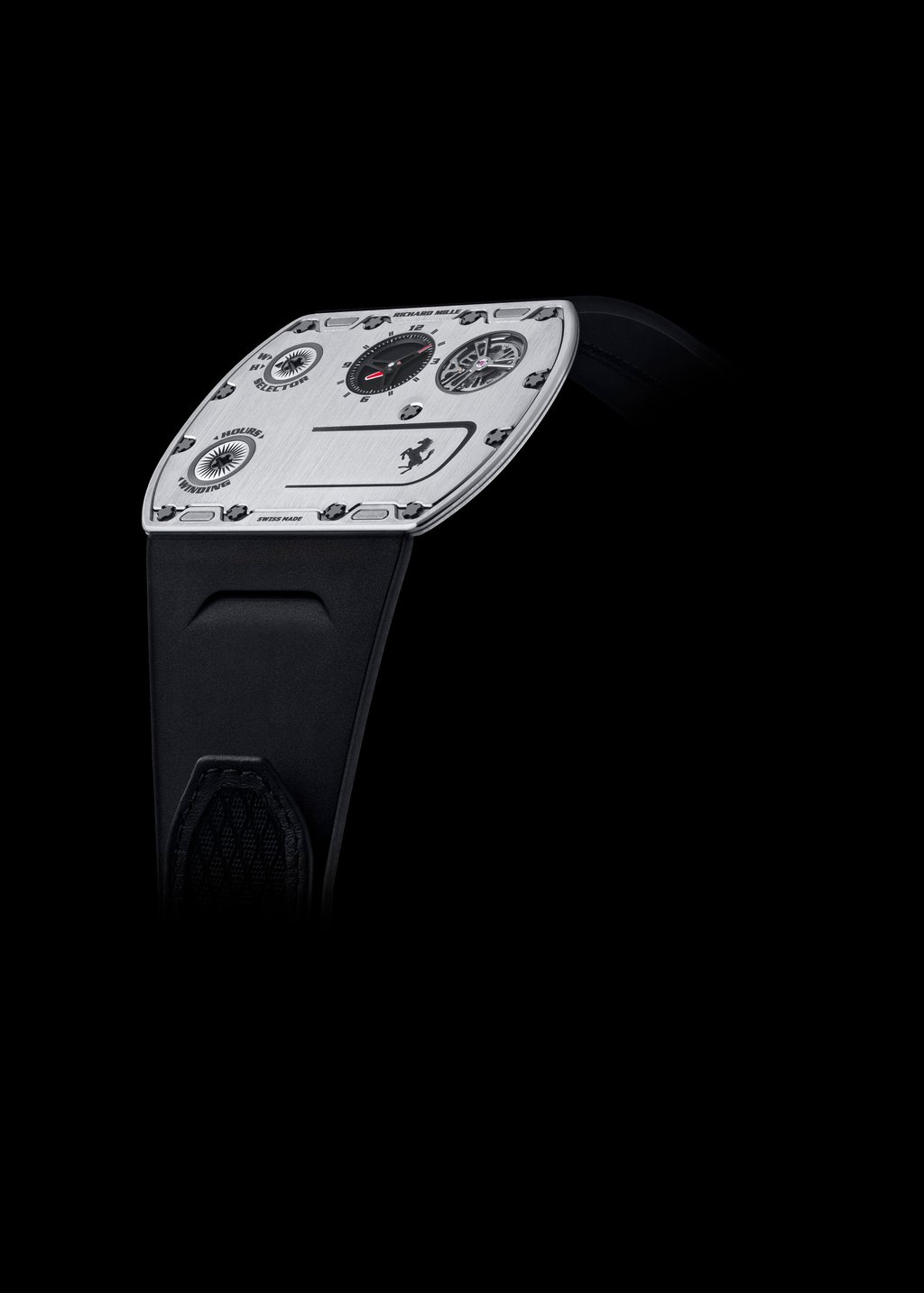
The Richard Mille RM UP-01 Ferrari is the brand’s thinnest timepiece to date, at just 1.75 mm thick. Photo: Handout
That sense of choice also connects to evolving expectations around comfort and wearability. A lightweight watch that sits almost imperceptibly on the wrist is no longer seen as lacking heft, but as a mark of sophistication. “It benefits anyone who appreciates lightweight design and, by extension, the qualities of subtlety and discretion,” says Hall. “Funnily enough, the classic dress watch was always intended to be sleek, discreet and unobtrusive – and those are qualities that titanium delivers in abundance.”
Titanium has been used in watches that push the boundaries of lightness and thinness to extremes. All the recent record holders of “world’s thinnest watch” have used titanium models, arguably to create lightness while offering as much durability as possible.