Future-proofing Hong Kong: Standard Chartered Business Summit charts next chapter of growth
Government officials, business leaders and industry experts join the bank’s executives to discuss how the financial hub can lead with innovation

Hong Kong stands at the crossroads of new opportunities shaped by a macroclimate of volatility, uncertainty and complexity. Now, its position as a superconnector between China and the world is more critical than ever.
With this in mind, Standard Chartered’s inaugural Hong Kong Business Summit 2025 considered how best to reassert the city’s advantage to unlock the potential of emerging sectors and newer types of investment. It also looked at creating stronger links with enterprises in the Greater Bay Area (GBA), all with the aim of enhancing global connectivity in these uncertain times.
The high-profile event in October – which brought together senior figures from government, banking, consulting, multinationals and the tech industry – highlighted successful corporate initiatives to promote sustainability and also examined the transformative impact and opportunities presented by artificial intelligence (AI).
Lively discussions about these topics served to illustrate how Hong Kong is now on the threshold of a new era, in which traditional industries and trade patterns are changing and digital disruption is accelerating, and highlighted the need to lead in new, innovative ways.
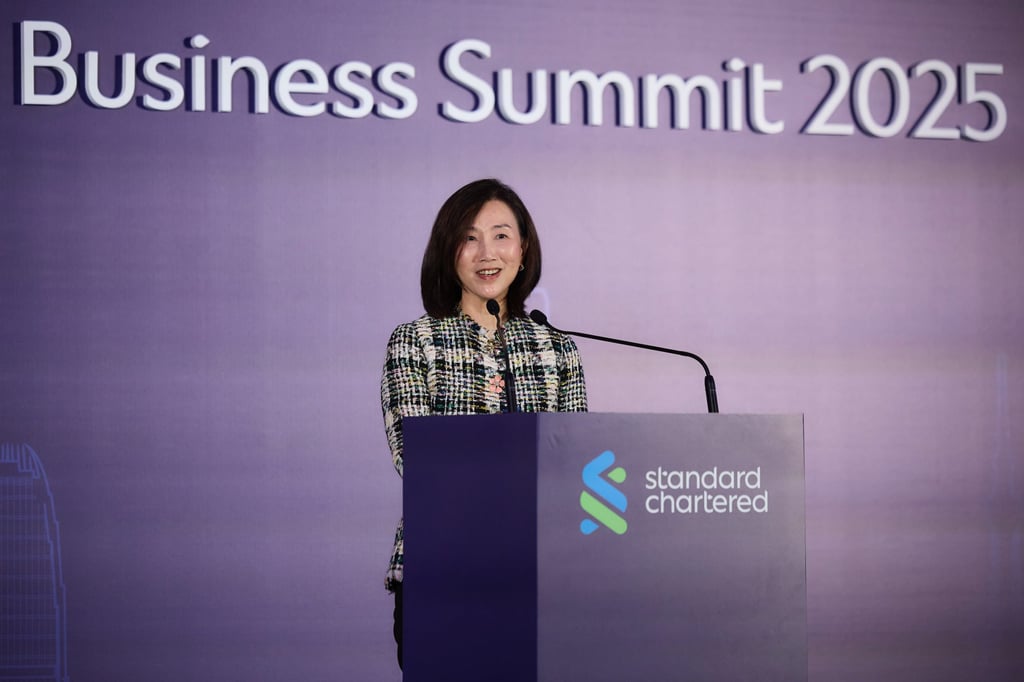
In her welcoming speech at the summit, Mary Huen, Standard Chartered’s CEO of Hong Kong, Greater China and North Asia, said new possibilities are emerging as the bank transforms traditional business models and helps drive change.
“Our task is to sharpen the edge and move with purpose towards a smart future, building an international financial centre with the very latest technologies,” she said.
The keynote address, delivered by Joseph Chan, the Hong Kong government’s Under Secretary for Financial Services and the Treasury, also underlined why Hong Kong can be confident in future-proofing its role and transitioning to the next phase of growth.
The benefits of free flows of capital, the common law framework, the “one country, two systems” principle and a simple, low-tax regime are all widely known, he said. When this is put in the context of ease of access to the mainland market and ambitious plans that link green finance expertise and environmental goals, core competitiveness is achieved. “It is a combination of hard policies, soft power and knowing how to interpret the latest developments and trends,” Chan noted.
As an example of how this works in practice, Fred Lam, chairman of the Airport Authority Hong Kong, explained how investment in new facilities will support long-term growth plans and transform Chek Lap Kok from “a city airport into an airport city”.
Key to that has been the opening of a third runway, which is now fully operational, and an expanding network of direct ferry links with cities in the GBA, as well as negotiations to handle more airlines and the building of a large-scale Skytopia retail and entertainment complex.
In a business plenary session hosted by Helen Hui, head of coverage, Hong Kong and Greater China for corporate and investment banking at Standard Chartered, Lam noted the airport now serves some 140 airlines, with connections to about 200 destinations worldwide. A key goal is to handle up to 120 million passengers a year by 2035.
“Back in 2017, we established a 10-year technology road map to help us become even more efficient and to give passengers a better experience,” Lam said, adding that the airport was one of the first to deploy driverless vehicles.
Hui noted investment in infrastructure would help future-proof the city: “Through financial innovation, regional integration and new growth sectors, Hong Kong has the ability to bounce back in times of uncertainty,” she said. “We have the international level, we have scale and we have the know-how. Hong Kong will always rise.”
Another panel discussion titled, “Capital and Impact: The New Sustainability Agenda”, explored how Hong Kong is positioning itself as an innovative ESG (environmental, social and governance) hub where emerging strategies are making ESG an engine for growth.
Panellists included Lesz Banham, vice-president and chief financial officer of Hong Kong Disneyland, who outlined initiatives to reduce the resort’s environmental impact by using AI and solar panels, as well as a programme to recycle water.
Meanwhile Debra Tan, head and director of CWR, a non-profit organisation that aims to make water usage and climate impacts central to corporate and financial decision-making, emphasised the scale of the challenges facing Asia. “There is an urgent need for plans that deal with the increasingly erratic global water cycle resulting from climate change,” she said.
Standard Chartered is mobilising US$300 billion in sustainable finance by 2030. Marisa Drew, chief sustainability officer at Standard Chartered, stressed that climate change and climate finance need to be front and centre of business models. “At its heart, it is about people. When we have extreme weather events it affects people and livelihoods.”
A separate panel discussion was concerned with the way innovation and technology are engineering the future of business. The panel comprised Simon Loong, founder and group CEO of WeLab, a pan-Asian fintech platform which offers digital banking and online financial services; Venetia Lee, CEO of AlipayHK, and Greater China general manager at Ant International; and Sunny Ip, partner at Deloitte Consulting. AlipayHK is an affiliate of Alibaba Group Holding, owner of the South China Morning Post.
The panel noted AI in particular is changing the nature of work and rewriting the way industries perform, and how it will also create new revenue streams. The panellists discussed breakthrough technologies that have the potential to cement Hong Kong’s role at the cutting edge of a new era of growth.
The summit was accompanied by the fourth edition of the Standard Chartered Corporate Achievement Awards ceremony, organised in partnership with the South China Morning Post. The awards recognise the achievements of corporations in Hong Kong and the GBA in sectors such as cross-border business, sustainable development and innovative technology.