Chinachem Group Sustainability Conference 2024 examines impacts of climate change
Leaders from business, government and academia gather in Hong Kong to discuss sustainability solutions for a more liveable future

Shining the spotlight on action and achievable goals, the Chinachem Group Sustainability Conference 2024 brought together noted experts from business, government and academia to discuss vital issues that will reshape our world in the decades ahead.
The hybrid event, which was held in Hong Kong last month, attracted more than 5,000 participants in-person and online, an increase of 60 per cent on last year. They learned about the latest challenges and successes in efforts to combat climate change, as well as innovative initiatives to promote impact investing and scale up sustainable finance.
Co-organised by the Business Environment Council and the Hong Kong Green Building Council, this year’s conference featured keynote speeches and panel discussions around the theme of “Integrating sustainability solutions toward a resilient future”.
“The aim of the conference was to tackle the urgent challenges of climate change, while also driving meaningful impact for long-term social and environmental well-being,” said Wong Hung-han, executive director and chief operating officer of Chinachem Group, which is fully committed to promoting sustainable development and making Hong Kong a more liveable city. “We brought together representatives from various sectors, uniting them in a collective endeavour to explore innovative strategies.”
The theme provided a diverse range of local and international speakers with the opportunity to share ideas and opinions on how best to address the challenges posed by climate change and find the resources needed to build an equitable and inclusive future.

To this end, the practice of impact investing is essential. It ensures that funds are directed towards projects that generate beneficial, measurable social or environmental changes in society, and target specific sectors such as clean energy or improving access to healthcare or housing. Sustainable finance, meanwhile, takes a multifaceted, long-term approach to investments that prioritise the environmental, social and governance impact of companies, alongside competitive financial returns. Both play an important role in addressing the global challenges of climate change, through the implementation of investment strategies that support a more resilient and sustainable future.
And, as part of the collaborative effort to chart a course towards a greener, healthier and more resilient future, the conference sought to provide constructive recommendations for the interim review of Hong Kong’s Climate Action Plan 2050. This is scheduled to take place next year.
Speakers at the morning session, which included representatives from government and academia, noted the importance of using the latest climate science data when making decisions about infrastructure and the built environment. Evolving projections and risk assessments are now crucial in the work of architects, planners and engineers as they look for the most effective designs to increase resilience against the adverse effects of climate change.
These professionals, the speakers noted, have a duty to translate complex scientific findings into practical applications and, along with input from policymakers, devise solutions to address real-world challenges, both existing and foreseeable.
A subsequent panel discussion turned to the topic of sustainable financing and impact investment, and highlighted the urgent need to address “resilience gaps”, especially in vulnerable communities. Such people often suffer greatly from the impact of climate-related events, and with this in mind, financing instruments must be tailored to help them get through immediate crises and be better prepared for other such events.
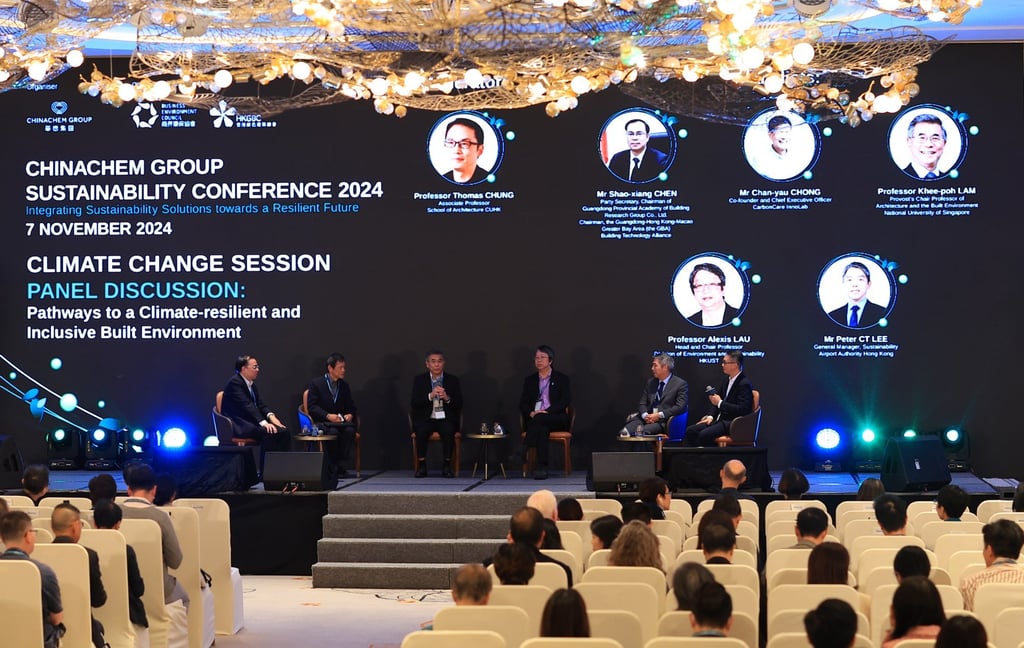
The speakers assessed innovative insurance products and financing models that can be scaled up, emphasising how these initiatives should not only benefit at-risk communities, but also seek to reduce social inequalities.
The conference series also champions start-ups, providing them with opportunities to showcase innovative solutions to create a better, more resilient environment in Hong Kong and further afield.
Chinachem Group has set a goal of reducing the carbon emission intensity of its own operations by 51.8 per cent by 2030, using the company’s 2020 figures as a baseline.
Achieving this requires a multifaceted approach, which includes upgrading the air-conditioning system at the group’s Nina Tower complex, a move expected to cut carbon emissions by at least 7,000 tonnes a year.
Steps have also been taken to employ modular integrated construction (MiC) technology when developing private residential projects, with the aim of minimising the environmental footprint and the impact on the local community in each instance.
As a result of these and other initiatives, the group says it is on track not only to meet its carbon reduction target by 2030, but also to achieve net zero by 2050.
The group, which has earned recognition for its sustainability efforts including the Hong Kong Management Association 2024 Best Annual Reports Awards for Excellence Award in Environmental, Social and Governance Reporting, published its first annual sustainability report in 2020 as part of a transparency drive and its commitment to reporting its sustainability progress with stakeholders.