Business leaders reveal how SMEs can scale their operations amid economic uncertainties
Forum organised by Standard Chartered highlights Singapore as a strategic gateway for firms entering China and other Southeast Asian markets

Small and medium-sized enterprises (SMEs), especially those engaged in cross-border trade, are facing challenges in the current geopolitical and economic environment, including tougher trade barriers, market access uncertainty, potential supply chain disruption, currency exchange volatility and the threat of rising costs.
However, companies that are supported by the right partner that can offer them in-depth insights into major market investment trends and sophisticated technological and financial support will be able to transform these challenges into opportunities to help expand their businesses.
Last month more than 120 company executives and entrepreneurs gathered in Singapore for the half-day “Superconnections: The Business Opportunities Between SEA (Southeast Asia) & China” forum, which explored how SMEs can maximise their growth potential by leveraging the city state’s strategic position as a launchpad into Southeast Asia and China.
Leaders in banking, investment and regional trade policy shared expert insights during a panel discussion which highlighted the Lion City’s status as a global financial hub with a state-of-the-art infrastructure and strong connectivity with its fellow members of the Association of Southeast Asia Nations (Asean) and China.
The event, organised by Standard Chartered in collaboration with the South China Morning Post, also included a presentation on macroeconomic and investment outlook and a networking luncheon which enabled guests to connect with other like-minded executives and entrepreneurs.
“Cross-border trading involves intricate considerations and strategising,” said Xie Wen, global head of SME Banking at Standard Chartered, during her opening keynote address. “We’re honoured to have a group of specialists and experts here with us today to share their insights, and spotlight high-impact opportunities across trade, digitalisation, sustainable development and cross-border collaboration.”
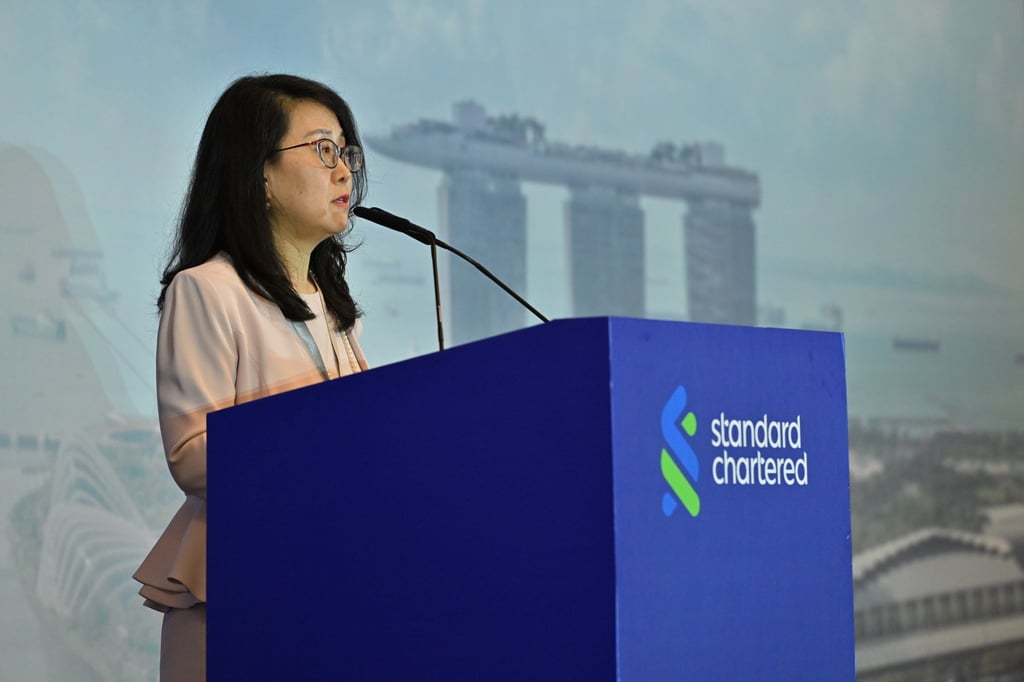
She also highlighted Singapore’s status as a global trading hub, its world-class infrastructure and strong connectivity with the rest of Asia as some of the main reasons why the country “stands out as a resilient choice” for SMEs to establish their regional presence.
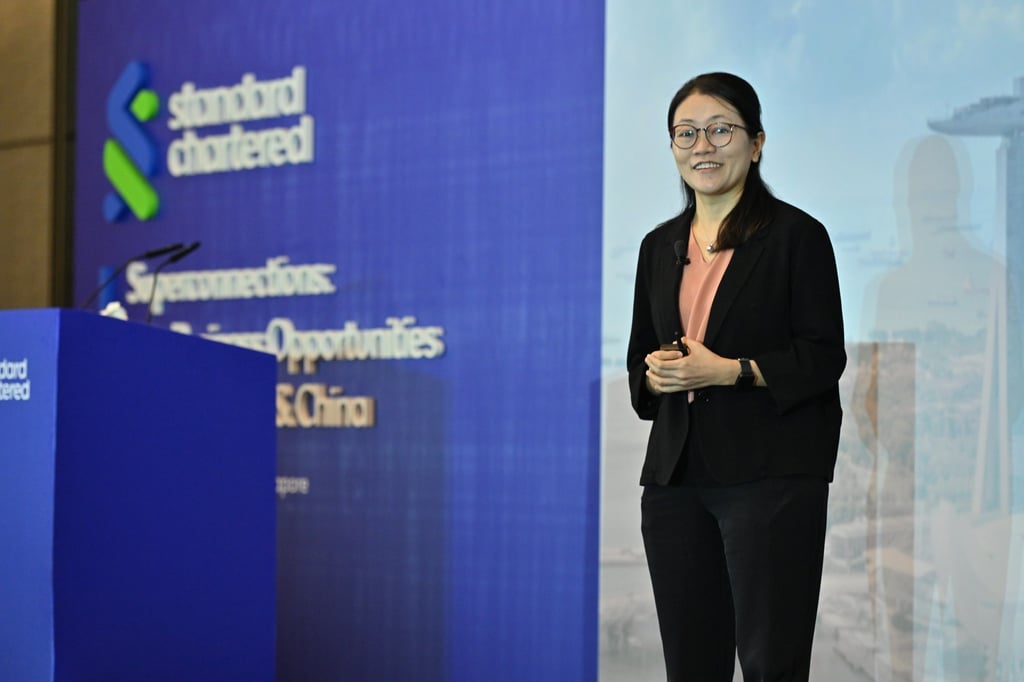
Audrey Goh, head of asset allocation at Standard Chartered’s Wealth Solutions Chief Investment Office, provided a detailed trend forecast on major currencies, key asset classes and the outlook for major markets around the world.
She also shared investment strategies and insights that could help individuals and businesses weather uncertain economic times against a volatile backdrop of trade tariffs and declining interest rates.
“It is important that our clients hold portfolios that can ‘attack’ and ‘defend’,” Goh said. “At Standard Chartered we construct our portfolios in a diversified way, where we have some ‘attacking’ assets, such as equities, which provide the prospect and the potential for long-term growth. These are matched with ‘defensive’ or more stable assets like bonds, to deliver income and help to provide stability in our clients’ portfolios.
“Ultimately, building wealth for the long term is about ensuring that their portfolio is able to stay resilient throughout the journey to harness growth opportunities that markets can provide.”
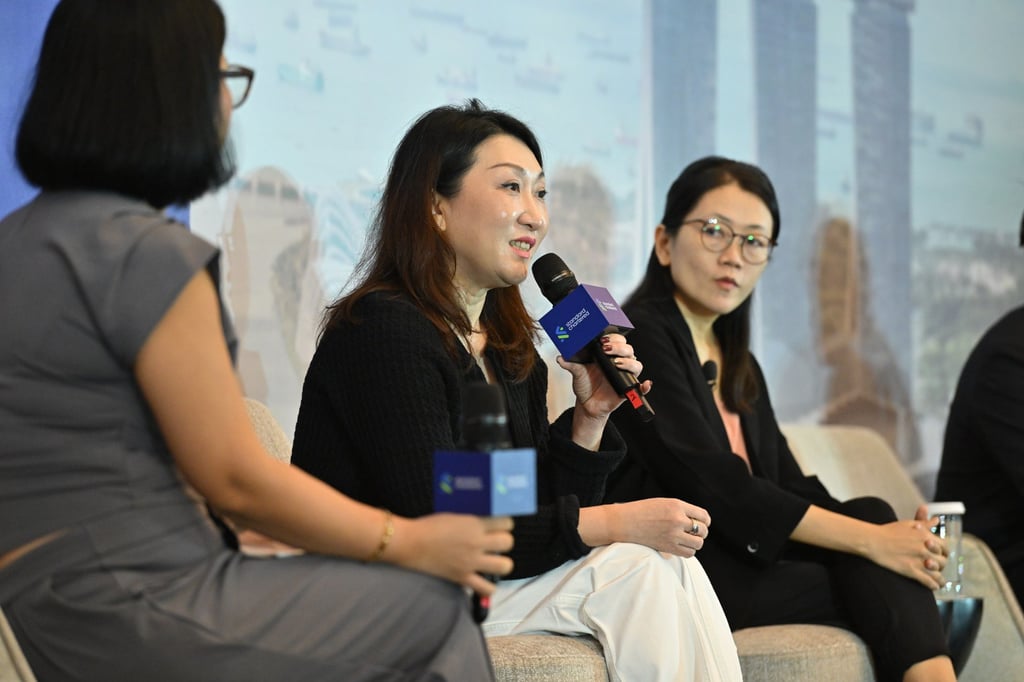
The panel discussion, titled “Maximising Regional Opportunities: Leveraging Singapore’s Strategic Position to Expand in Asean and China”, outlined the importance of SMEs – which make up 97 per cent of Southeast Asia’s businesses and employ 67 per cent of its workforce – to the region’s economy.
Along with Goh, Teresa Tah, Standard Chartered’s general manager of SME Banking in Singapore, Henson Tsai, founder and CEO of tech start-up SleekFlow and Timothy Zee, non-executive chairman of global business development firm Altios International, shared insights into the challenges that SMEs face when they expand beyond Singapore into Asean and China.
These difficulties include navigating complex regulatory environments in each market, the lack of access to funding, overcoming language barriers and differences in culture and business practices, establishing reliable supply chains and keeping up with technological advances.
“Finding the right partners is key when entering a new market,” Tah said. “Companies can struggle if they don’t have the right local partners to help them scale efficiently. At Standard Chartered, we help clients navigate cross-border expansion with our customised solutions such as trade and working capital financing, cash management and foreign exchange services so they can operate smoothly.”
She illustrated how the bank supports its clients’ cross-border banking needs with the example of a food supplier that managed its procurement, distribution and sales teams from Singapore while its manufacturing operations are based in Malaysia – an arrangement that caused operational inefficiencies owing to inter-company billing.
“We worked with our Malaysian team to extend banking facilities locally, allowing the client to streamline its procurement process,” she said. “Our client not only doubled its factories from two to four, it grew its sales volume significantly too.”
Additionally, Standard Chartered recently announced its strategic partnership with global advisory firm Altios to support the bank’s SME clients in establishing their overseas presence across Asia.
“Standard Chartered is one of the few international banks offering comprehensive banking and financing services, and expertise in some of the world’s most dynamic markets and investment and trade corridors across Asia, Africa and the Middle East,” Xie said.
“Our suite of innovative solutions are curated to address the intricate needs of businesses expanding across borders. We are well-placed as a banking partner to connect our clients to growth opportunities and support them to scale internationally.”