Hong Kong green tech trailblazers boost sustainability across belt and road countries
Start-ups i2Cool and Archireef tackle global warming challenges with innovative technologies and inventions in the Middle East and beyond

Despite its reputation among many people as a concrete jungle, Hong Kong is one of the most biologically diverse places in Asia, making it a great location for testing new innovative solutions that can help tackle environmental challenges facing the planet.
As such, the city is emerging as a leader in sustainability and green innovation. With over 250 green tech companies working on solutions in renewable energy, sustainable materials and decarbonisation, Hong Kong is playing a pivotal role in turning the Belt and Road Initiative’s environmentally friendly vision of the future into tangible reality.
This global platform, initiated by China in 2013, is designed to boost trade and economic partnerships while fostering cross-border collaboration in fields such as healthcare, digitalisation, innovation and green development.
During Hong Kong Chief Executive John Lee Ka-chiu’s five-day visit to Qatar and Kuwait last month, he highlighted the city’s expertise in green development and said that Hong Kong companies were already engaged in key projects such as no-electricity cooling technology and marine reef restoration in the region.
Moreover, the city can play a role in helping Middle Eastern countries to drive growth in green innovation, diversify their economies and encourage more collaboration between Hong Kong, mainland China and the region.
The visit, which involved a delegation of more than 50 business leaders from the city and the mainland, built on the success of his 2023 visit to Saudi Arabia and the United Arab Emirates (UAE) and continued to strengthen the foundation for Hong Kong enterprises to expand into the Middle East.
Tackling challenges caused by climate change is now at the forefront of the global development agenda, with the World Meteorological Organization reporting that last year was the warmest year on record. For example, Hong Kong’s Electrical and Mechanical Services Department revealed that air conditioning accounts for almost 30 per cent of the city’s electricity consumption, which is contributing to rising energy costs and carbon emissions.
To help people keep cool, Professor Martin Zhu and a team of scientists and engineers at City University of Hong Kong (CityU) have created a low cost, electricity-free cooling coating inspired by the hair structure of Saharan silver ants to reduce the cost of cooling buildings.
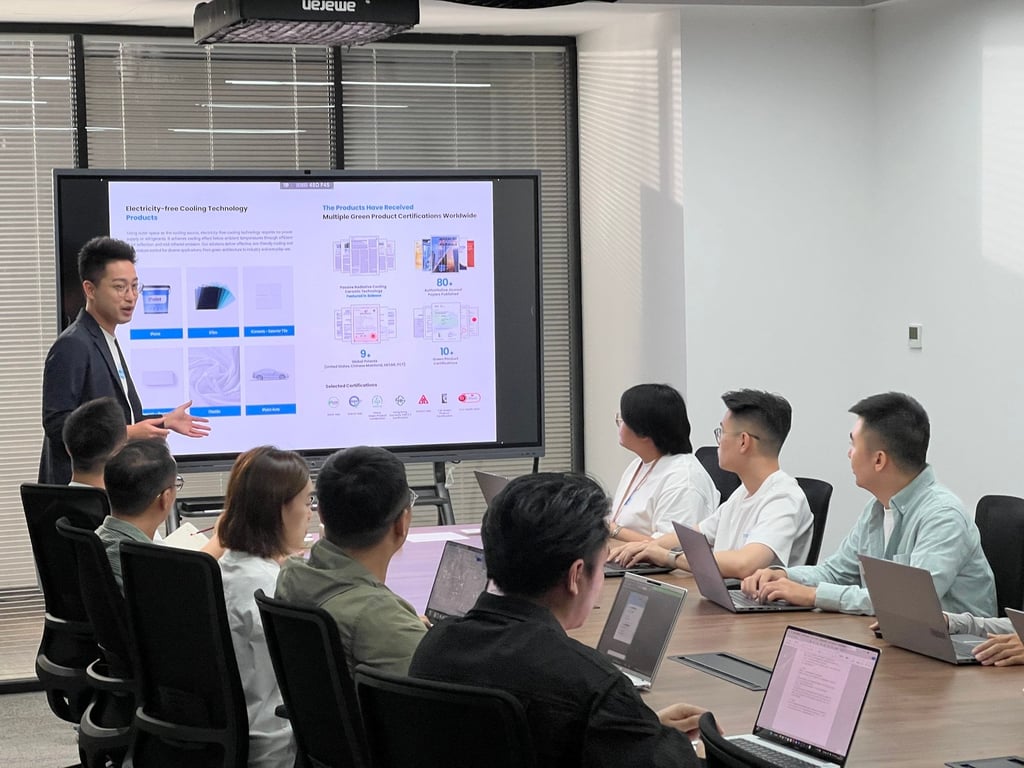
Dubbed i2Coating, it is the flagship product of i2Cool, the technology start-up which was founded in 2021 by Zhu and his PhD supervisor, Professor Edwin Tso, who is now the associate dean of the School of Energy and Environment at CityU. They established the company with the support of the university’s HK Tech 300, an innovation and entrepreneurship programme that provides funding and training for the university’s students, and the Hong Kong Science and Technology Parks Corporation, which works to foster innovation and technology development in Hong Kong.
When i2Coating, which contains a mixture of polymers and nanoparticles with passive radiative cooling technology, is applied to the rooftops and exterior wall of a building, it helps lower the surface temperature by up to 42 degrees Celsius (107.6 degrees Fahrenheit) and the indoor temperature by up to 10 degrees, resulting in a 42 per cent reduction in energy use for air conditioning.
Despite the lack of experience in managing a business and large-scale manufacturing, Zhu, who is also the CEO of i2Cool, says his company found success quickly. Over the past four years, its product portfolio has continued to expand and it now has a presence in 29 countries, including those in the Middle East, where the hot climate makes i2Cool’s energy-efficient cooling solutions especially valuable.
In the UAE, for example, i2Cool worked with Emaar Properties, which found out about the start-up’s cooling solutions after its representatives saw Zhu give an interview at an event organised by Hong Kong’s Belt and Road Office.
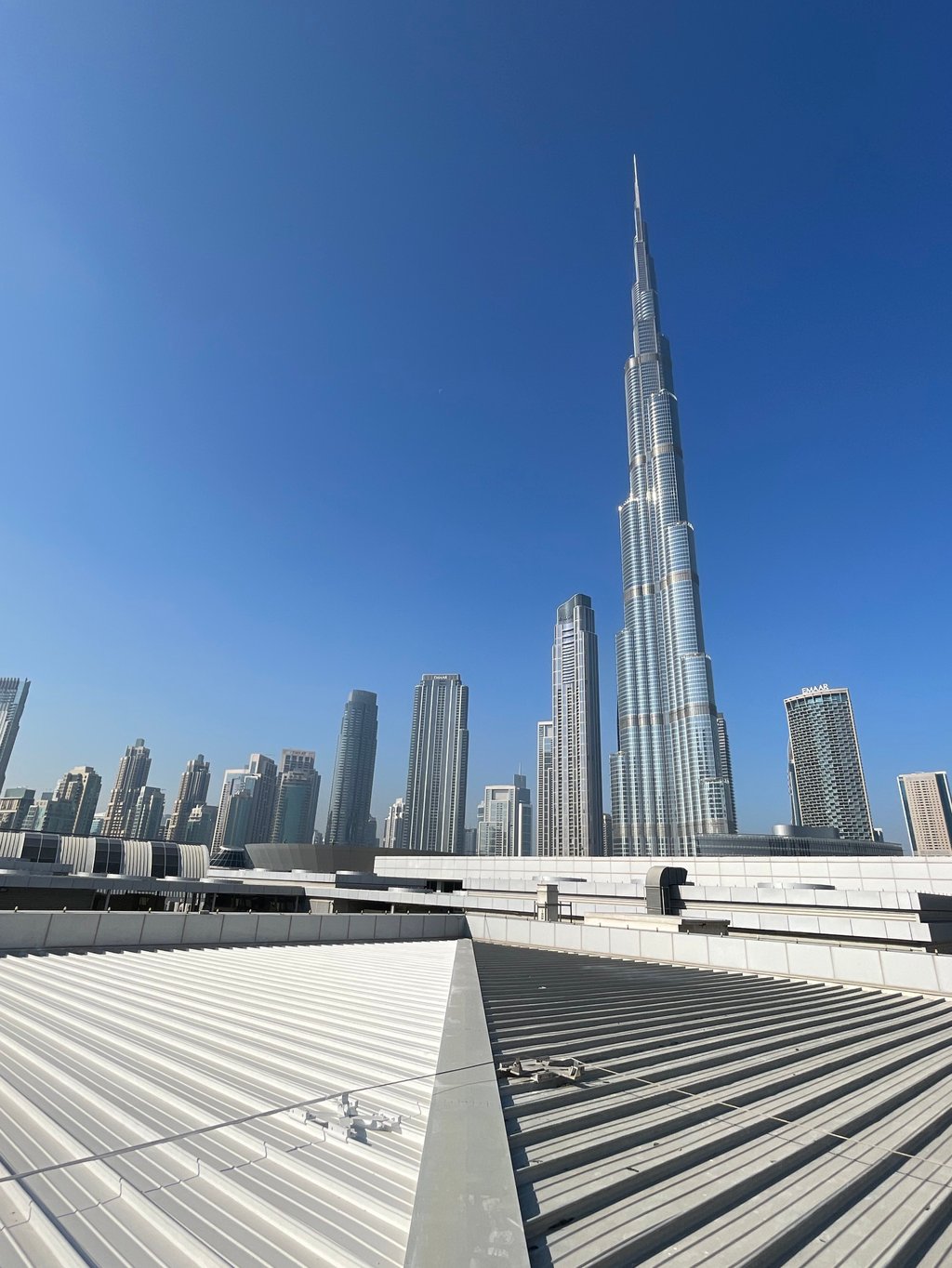
The start-up was invited to join an innovation challenge hosted by the UAE-based property developer, and later secured a deal to apply i2Coating to the Dubai Mall’s rooftop, which helped the shopping centre achieve a 20 per cent reduction in air-conditioning energy consumption.
It has also entered into a strategic partnership with the UAE-based Leading Hospitality Services group, which will help market and distribute i2Coating in the Middle East, Levant and Africa. Additionally, it is also working with distributors across Southeast Asian countries, such as Vietnam, Philippines, Malaysia, Indonesia and Singapore, to sell its products.
Zhu sees Hong Kong as a great testing ground for companies aiming to scale. With access to resources such as a skilled talent pool in the Greater Bay Area, the city provides an ideal environment for green tech companies like i2Cool to grow and innovate.
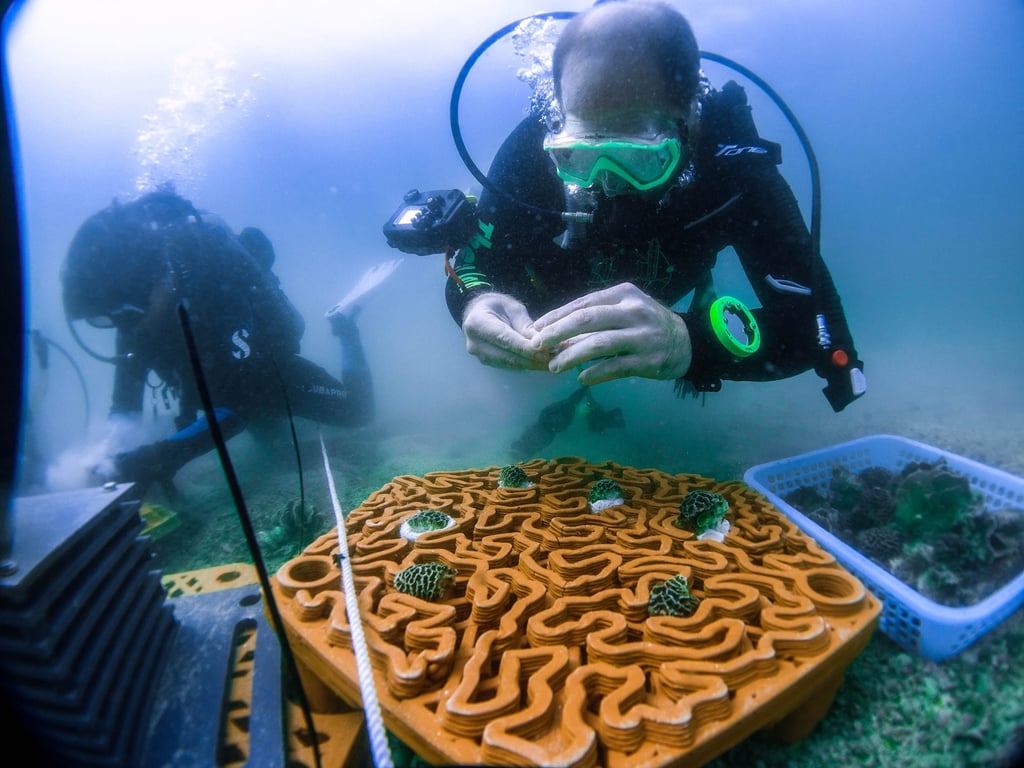
While urban innovation addresses land-based challenges, rising ocean temperatures are threatening coral reefs, which are biodiversity strongholds and critical for economic livelihoods. Hong Kong-based start-up Archireef is helping to restore coral reefs worldwide using 3D-printed terracotta reef tiles.
The tiles, which mimic natural reef structures and can be customised to match locations in a variety of terrains, are mounted on adjustable 3D legs and then placed on the seabed by divers. They provide a stable, non-toxic substrate for corals to latch onto and thrive. Archireef reports this method has achieved a 95 per cent coral survivorship in the first three years after initial deployment in Hong Kong and up to 40 per cent biodiversity enhancement within six months.
Vriko Yu, co-founder and CEO of Archireef, was born and raised in the Hong Kong countryside, which sparked her love of nature. Frustrating attempts to restore the city’s coral community using traditional methods and tools, such as plastic pipes, reinforced metal bars and concrete blocks, led her to establish her company in 2020 while studying for her doctorate in biological science at the University of Hong Kong.
“Hong Kong really is creating an environment to nurture green and blue tech start-ups,” she says. “It’s not just about the financial support and the capital to kick-start the business, but it’s also about the mentorship opportunities offered through government-supported incubation programmes at universities and organisations such as the Hong Kong Science and Technology Parks Corporation and Cyberport.
“As a scientist, running a business is not part of my DNA. These programmes have helped us to establish Archireef as a viable business in the city and fuelled our expansion into the Middle East and beyond.”
In 2022, Archireef partnered with ADQ, a sovereign wealth fund in Abu Dhabi, which works to accelerate the Emirate’s transformation into a knowledge-based economy, and the Environment Agency – Abu Dhabi, the Middle East’s largest environmental regulator, to use its terracotta tiles to aid the Persian Gulf’s coral restoration. The following year, the First Abu Dhabi Bank, the Middle East’s largest bank, pledged funding to deploy 400 reef tiles off the coast of Abu Dhabi.
Since then the company has set up the world’s first eco-engineering facility in the Emirati capital’s Khalifa Industrial Zone to help businesses in the UAE reach their environmental goals.
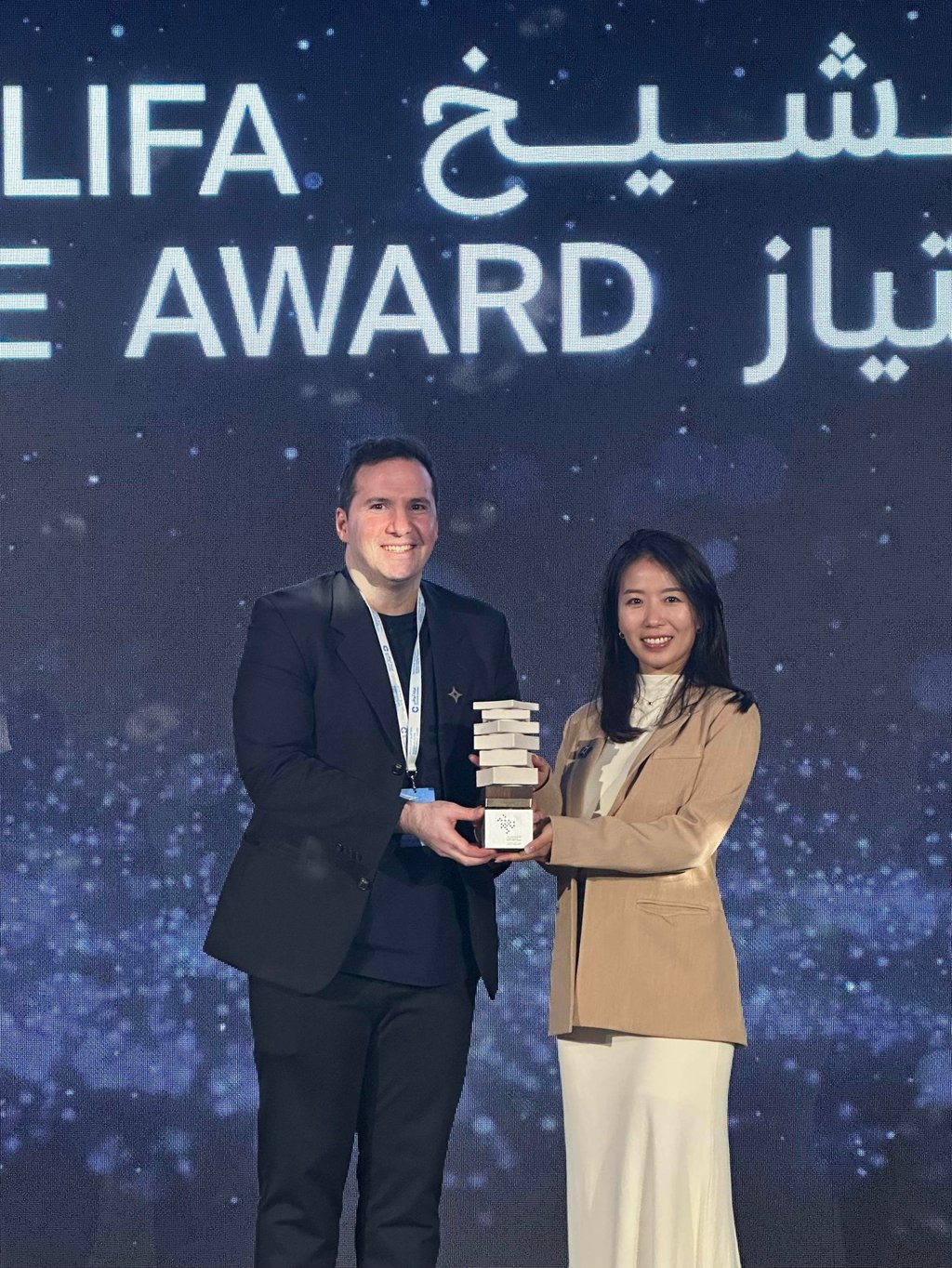
Earlier this year, Archireef received the Sheikh Khalifa Excellence Award for its innovative solutions in reviving Abu Dhabi’s marine ecosystems and its commitment to improving sustainability through its technology.
In Saudi Arabia, Archireef is working with King Abdullah University of Science and Technology Coral Restoration Initiative to test the impact of its tiles in the Red Sea. It placed more than 90 of its horizontal and vertical reef tiles across three sites around Shushah Island to support coral growth and ecosystem growth. As part of this collaboration, the two parties also transplanted 540 coral fragments onto its tiles on a large-scale coral reef restoration programme in the Red Sea.
Yu says the Hong Kong government played a crucial role in helping her company expand into the country. “Hong Kong’s Belt and Road Office introduced us to the Ministry of Foreign Investment in Saudi Arabia, which helped us to fast-track our plans by putting us in touch with the right people and resources,” she says. “That’s really important, especially for a start-up like ours.”
While the Middle East will be a core focus for Archireef in the next three to five years, Yu says her company’s research and development activities will still be conducted in Hong Kong because of the city’s ability to attract talent in various fields. Additionally, its unique ecology makes it an ideal testing ground for coral restoration technologies and a launchpad for expanding into Southeast Asia.
“Hong Kong is like a crystal ball for climate change,” she says. “Despite being heavily urbanised, the city has about 80 coral species, which is more than the entire Caribbean Sea. What I’ve been seeing in Abu Dhabi is what Hong Kong was going through 30 to 50 years ago. We can bring the lessons learned from Hong Kong to make sure we’re executing it better and introducing interventions earlier in this part of the world.”
Both i2Cool and Archireef took part in the Discover Neom event in Hong Kong, co-organised by the city’s Belt and Road Office, in April last year, to help local and mainland firms explore opportunities in the planned sustainable desert megapolis near the Red Sea coast in Saudi Arabia.
Looking ahead, the 10th edition of the Belt and Road Summit, which will be held in September, will serve as a platform for government officials and business leaders to explore opportunities for multilateral collaboration.
“The Hong Kong government has done very well in setting up various platforms and also introducing the policies to boost green development and encourage the development of home-grown green technology,” Zhu says. “Start-ups should also take advantage of the annual Belt and Road Summit and join business delegation visits to connect with more potential clients overseas.”