Hong Kong firms’ telecoms and fintech expertise adds value to belt and road countries
PCCW Global boosts worldwide connectivity while AnchorX’s offshore yuan-linked stablecoin facilitates trade with Kazakhstan

Both long-established companies and young start-ups in Hong Kong are playing a pioneering role in an exciting new age of global expansion.
In finding ways to collaborate for mutual benefit, local technology-driven enterprises are making an impact by bringing the city’s professional expertise and quality services to countries which are part of the Belt and Road Initiative.
This global platform, launched by China in 2013, was designed to boost trade and economic partnerships while fostering cross-border collaboration in fields such as healthcare, digitalisation, innovation and green development.
Meanwhile, the Belt and Road Office in Hong Kong, which was established to promote the city’s full participation in the initiative, is dedicated to helping these companies leverage the city’s strengths to seize business opportunities.
In addition to energising their business landscapes, these firms are also helping to advance two-way trade between these places and mainland China, while paving the way for more exchanges, deals and partnerships, and generally promoting multilateral cooperation.
In this respect, PCCW Global, the international telecommunications arm of Hong Kong’s HKT, and AnchorX, a financial technology (fintech) start-up founded in late 2023, serve as two outstanding examples.
PCCW Global is a leading international provider of voice and data services carried via an extensive network of submarine cable systems and satellite systems.
AnchorX is ready to offer digital currency solutions, using its own offshore yuan-linked stablecoin, AxCNH, to accelerate settlement of cross-border trade transactions and encourage wider adoption of virtual assets.
In their respective fields, both have been quick to see the potential in working with belt and road countries and are now building on the success of initial projects and planning for a whole new range of possibilities.
“We have a global coverage with a multinational network,” says Frederick Chui, CEO of PCCW Global, which has a presence in more than 60 cities and a wide range of clients that includes mobile operators, multinational enterprises and hyperscalers – large-scale data centres that can deliver computing power and storage capacity to enterprises and individual users worldwide.
“There is a physical network and, on top of that, the various applications that facilitate data movement, which can be to, or from, a data centre or in the cloud.
“We have also launched an on-demand platform that provides customers with automated connectivity to more than 1,000 data centres and 250 cloud zones around the world.”
This ensures PCCW Global’s customers are able to use cutting-edge services anywhere in the world, including in mainland China, the Asia-Pacific region, the Middle East, Europe, Africa and the Americas, and timely upgrades are all part of the plan.
“When investing, we look at the supply and demand, where data wants to move, and which parts of the world lack capacity,” Chui says.
“In terms of GDP [gross domestic product] and market opportunities, belt and road countries can be very lucrative areas for investment because we are confident the traffic will grow.”
At present, PCCW Global is focusing on developments in the satellite industry and what high-speed, low-latency low Earth orbit (LEO) satellite technology can achieve. Crucially, it can provide uninterrupted coverage in very remote locations, giving access to the internet and broadband applications which can bring opportunities in fields such as education and telemedicine.
It is now working with a mainland partner which is building a LEO constellation, and both are excited by the practical benefits for the maritime, aviation, oil and energy sectors, as well as for direct-to-cell broadband services for ordinary mobile phones.
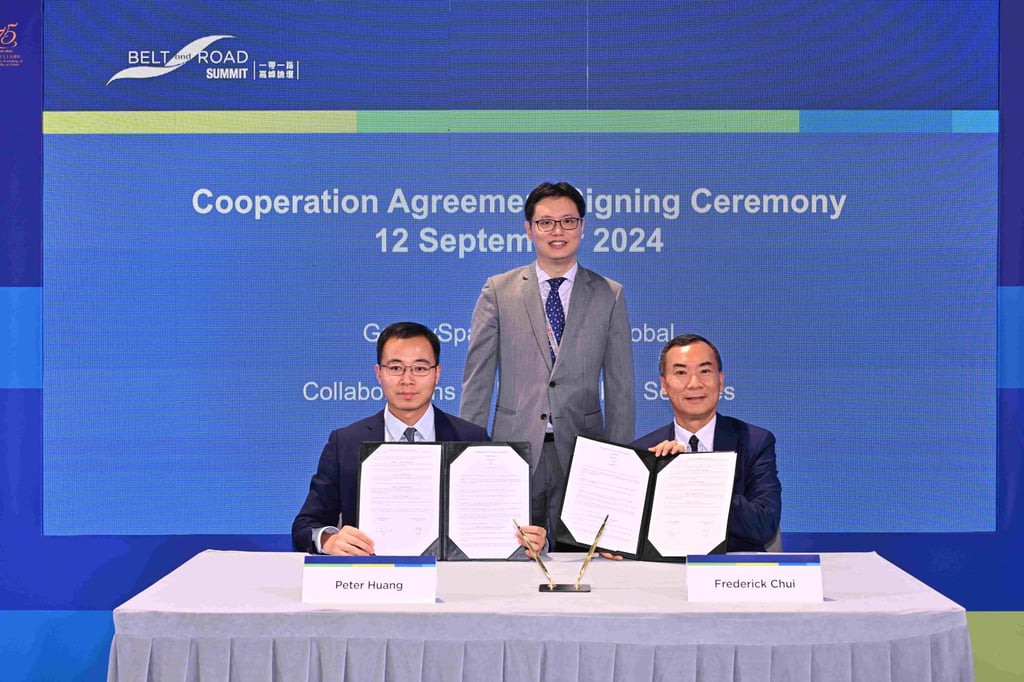
“We signed an agreement at the 9th Belt and Road Summit last September, and our mainland partners are extremely interested in expanding coverage and rolling out services in Asia, the Middle East and Africa,” Chui says.
“It is a perfect match: their technology and our global reach and sales coverage, with people on the ground who understand the local rules and regulations.”
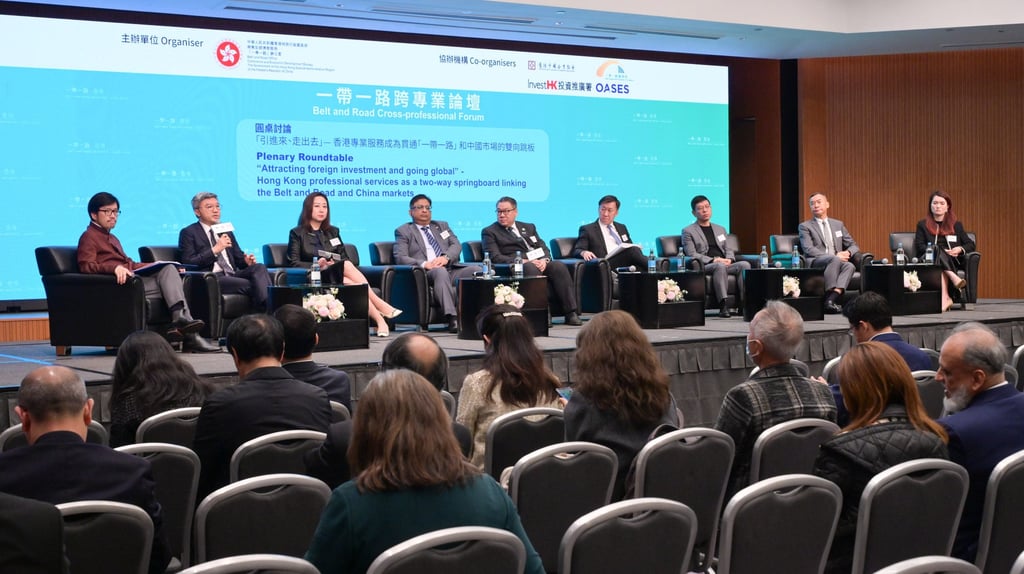
Noting the importance of always having projects in the pipeline, Chui is quick to acknowledge the role played by the Belt and Road Office, which organises outbound missions, project matching activities and industry events such as February’s Belt and Road Cross-professional Forum, where Chui spoke at a panel discussion on global supply chain management and construction projects.
“These events allow us to gain insights from other success stories, network with business leaders and tap into new opportunities,” he says. “The forum highlighted how Hong Kong’s high-quality professional services can help to attract foreign investment and connect belt and road regions with the Chinese market.”
For AnchorX, too, wide-ranging support from the Belt and Road Office has been a key factor as the company pushes ahead with its plans to set up operations in Kazakhstan.
The objective there is to issue stablecoin, a form of digital currency supported by secure blockchain technology. Each stablecoin token is linked to a fiat currency, in this case the offshore yuan, and fully asset-backed by a bank or licensed financial institution.
AnchorX sees great potential in using these tokens for settling payments between trading partners, which is faster, more convenient and has lower transaction costs compared with transfers via the Swift interbank system.
The World Economic Forum, the Swiss-based not-for-profit foundation, reports that the use of stablecoins has increased steadily over the past few years, with a 28 per cent year-on-year growth in its average supply in circulation. The total global transfer volume of stablecoins reached US$27.6 trillion last year.
“Today, probably 99 per cent of stablecoins are US dollar-denominated, but we believe there is definitely a space for Asia-based currencies,” Hill Wang, founder and CEO of AnchorX, says.
“A growing amount of trade between China and the belt and road countries is in offshore yuan, so with our AxCNH stablecoin we see a chance to differentiate and play to our advantages.”
Its interest in working with Kazakhstan was the direct result of participating in a joint delegation to the country organised last May by China’s Ministry of Commerce and Hong Kong’s Belt and Road Office.
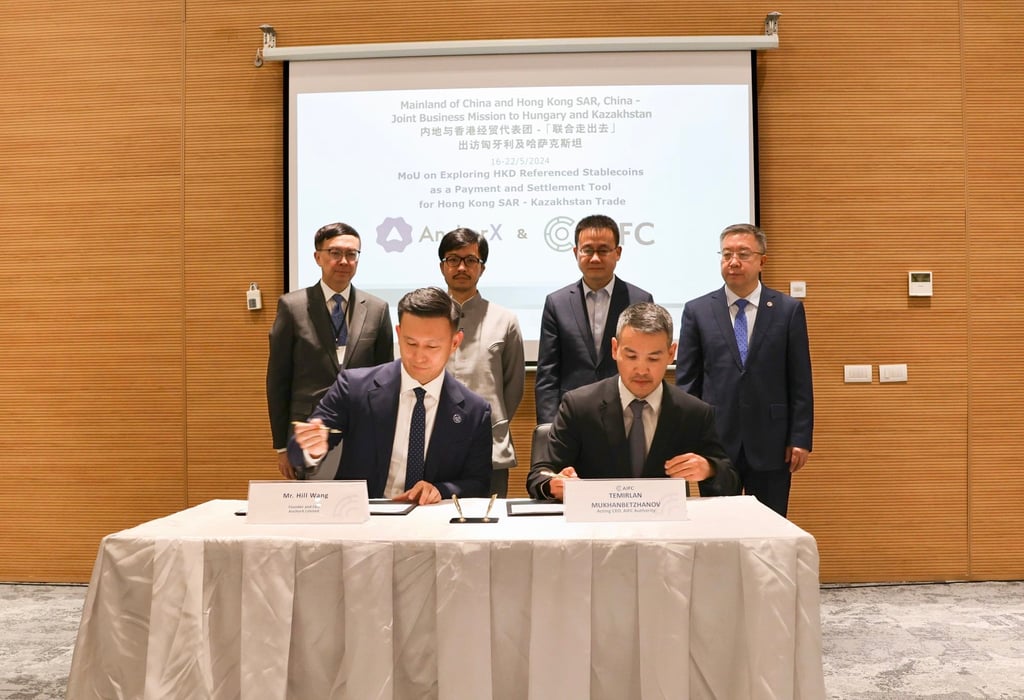
“During that trip, we realised that Kazakhstan has a very supportive stance towards virtual assets,” Wang says. “They have already established a legal framework for stablecoins and have issued licences for crypto exchanges.
“Beforehand, the Belt and Road Office connected us with the Astana International Financial Centre (AIFC), which is like a special economic zone which follows common law and is very business-friendly towards international entities. Through introductions, we also made contact with the regulatory authority and started the application process for setting up a stablecoin business.”
Last month, Kazakhstan’s financial regulator, Astana Financial Services Authority, granted AnchorX approval to issue the AxCNH in the country. This marks the first stablecoin-related approval in the country.
Pilot trade settlements in AxCNH between Kazakhstan and Hong Kong are already in the implementation stage. Meanwhile, AnchorX is in discussions with licensed crypto exchanges in Kazakhstan with the hopes of launching its first stablecoins there in the next few months.
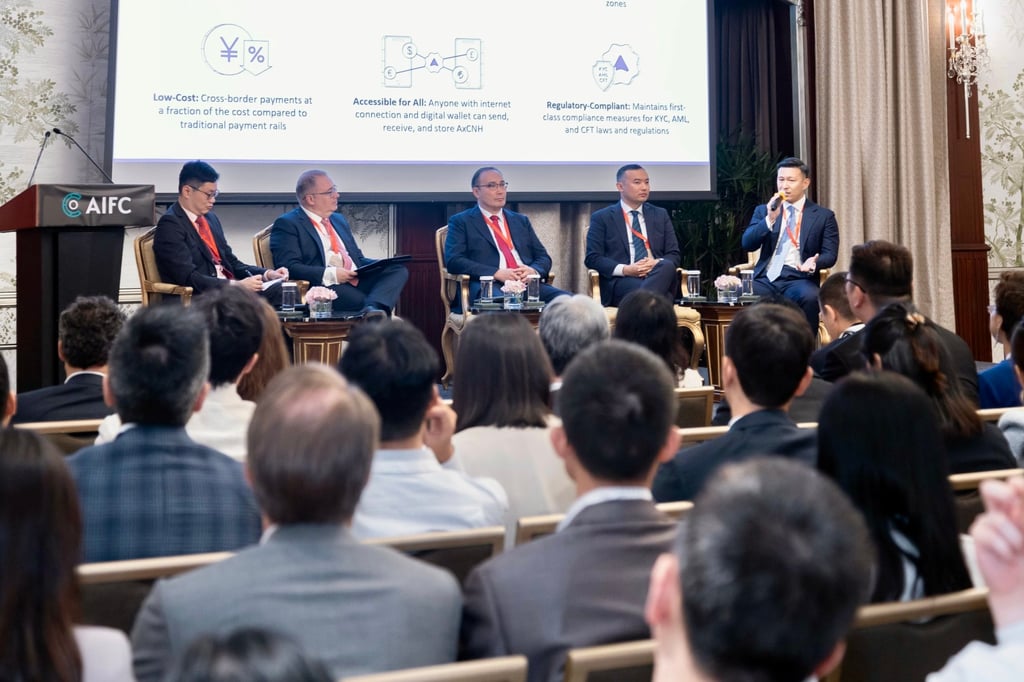
At last month’s AIFC Connect: Hong Kong event, focused on Kazakhstan’s capital market evolving financial services landscape in the rapidly growing Central Asian region, Wang shared his hope for AxCNH to serve as a “digital high-speed rail” for trade settlements between Chinese businesses and their belt and road partners. He is confident the offshore yuan-pegged stablecoin could have a market size which exceeds US$100 billion in the next three to five years.
With the Hong Kong government’s supportive stance on developing virtual assets and the fintech industry, Wang believes choosing the city as a base for AnchorX has many advantages.
“In addition to its well-developed financial and legal systems, and its connection with mainland China, Hong Kong is also the world’s largest offshore yuan hub – the city processes about 70 per cent of all settlement in the currency,” he says. “There is a lot of money flowing through the city, so it is important for us to have a presence here and leverage its advantages to expand overseas.”