Money 20/20 Middle East: the future of fintech growth
The global financial technology industry is booming, with the world looking to Riyadh

The future of money, how it is moved, managed and multiplied in the era of fintech and digital innovation, will be very much under the spotlight at the 2025 edition of Money 20/20 Middle East. Held in Riyadh from September 15 to 17, the event gathers all the right people – bankers, big tech and fintech leaders, regulators, start-ups and investors – in one place to share insights, drive innovation and create opportunities for business growth.
“Attendees expect something more than just another fintech conference, and that is what we will give them,” says Annabelle Mander, executive vice-president at Tahaluf. One of the fast-growing firms in the event organising sector, it plays a major role in executing events that align with Saudi Arabia’s Vision 2030, which aims to transform the kingdom into a global financial hub.
Money 20/20 Middle East is where that future will be built. The event, which will welcome more than 45,000 international attendees, 450 leading fintech brands, 350 prominent speakers and 400 investors alongside key decision-makers, government leaders and financial regulators, promises to be the best fintech show of the year, giving rise to an unparalleled surge of collaborations and partnerships.
“People will be coming to a place where real deals are done, policy conversations happen and breakthrough innovations will be on show,” Mander says. “It is where capital, technology and oversight connect in a way that creates tangible outcomes, not just dialogue and goodwill.”
Tahaluf’s ability to deliver events that provide real value for participants is built on solid foundations. A joint venture partnership with Informa, the world’s largest trade show organiser, and with the backing of the Saudi government, Tahaluf manages a portfolio of world-class events in diverse sectors, including award-winning tech events Leap and DeepFest, as well as Money 20/20’s previous edition in Riyadh, 24 Fintech. Later this year, Money 20/20 editions will take place in Las Vegas, Amsterdam and Bangkok, providing a global stage for leaders, investors and innovators shaping the future of fintech. In terms of size and scope, the Middle East edition is likely to set the standard for business deals, with representatives such as J.P. Morgan, UBS, Morgan Stanley and the Public Investment Fund of Saudi Arabia.
“We’ve been very deliberate in designing the event around the theme ‘Where Money Does Business’, but also in making sure every stakeholder group can extract real, tangible value,” Mander says.
Large-scale investors can spark value at Venturescape, a dedicated pre-event forum where global venture capital investors, family offices and fintech founders do business. Start-ups can access multiple entry points, including curated learning journeys and content zones designed to help them understand how to leverage partnerships as they scale up, while the MoneySurge 20/20 Pitch Competition, using AI-driven matchmaking to strategically connect stakeholders, offers selected creator companies US$400,000 in equity-free funding.
“What ties all of this together is the level of detail and precision in how we’ve built the programme. Every initiative, from matchmaking to investor-only briefings and embedded finance, has been informed by months of stakeholder consultation and analysis of what each group truly needs,” Mander says.

Five content pillars drive the agenda at Money 20/20. The first two focus on governance and regulation, which ideally should keep pace with rapidly evolving technologies such as artificial intelligence and data-driven services, which are already transforming fraud detection, credit scoring, the customer experience and much more.
The third pillar centres on how tech is pushing the boundaries of traditional finance through digital payments, blockchain deployment and automated advisory services – or robo-advisers. Pillars four and five explore strategies for scalable start-up growth and the rise of purpose-driven start-ups.
“These five pillars reflect where the industry is heading and will give delegates not just insights, but also an actionable framework which they can apply immediately in their own organisations,” Mander says. “Compared with our 2024 event, we are expecting a 100 per cent year-on-year increase in international exhibitors, showing the sheer momentum of the Saudi market. Everything is scaling in size and quality. That is why the world is looking to Riyadh.”
Among the many featured speakers, Mander highlights Deemah AlYahya, secretary general of the Digital Cooperation Organisation, who will explore how in times of economic uncertainty financial innovation can spur growth; Douglas Feagin, president of Ant International, who will discuss cross-border payments; and Caroline Pham, acting chairman of the US Commodity Futures Trading Commission, who will offer perspectives on global regulation.
From the world of banking, Mohammed Rahim, group chief data officer of Standard Chartered, will examine the ever-increasing power of data in finance. Separately, Nabeel Koshak, CEO and board member at the Saudi Venture Capital Company, will explore the nation’s rapidly growing fintech start-up scene and investment ecosystem.
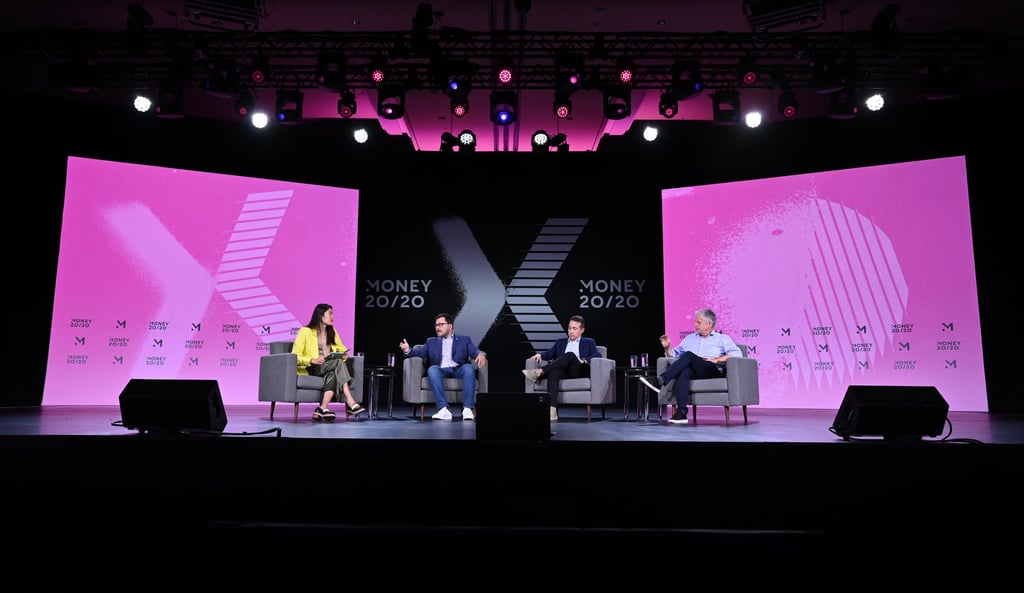
“These sessions will set a world-class tone from day one,” Mander says, noting that the event will showcase how digital transformation is a key driver of Saudi Arabia’s US$1 trillion economy and vital to future growth.
“The country has a young, digitally savvy population, an ambitious Vision 2030 road map to boost cashless transactions and online payments, and a government that is backing fintech at every level,” she says. “Add to that factors like global visibility and a regulatory ecosystem that is both progressive and collaborative, and there is every reason for optimism.”
Based on current estimates, Saudi Arabia’s fintech market will exceed US$4.5 billion by 2033, according to global management consulting firm Imarc. Well-positioned as a fintech hub for the Gulf region, a magnet for start-ups and global investors, and with the coordinated support of institutions such as the Saudi Central Bank, the Capital Market Authority, the Insurance Authority and Fintech Saudi, the economy may grow even faster than Imarc’s estimate.
There are many factors contributing to the kingdom’s prosperity, including Tahaluf’s facilitation of open dialogue, productive exchanges and stronger market linkages.
“We believe that the Money 20/20 Middle East event will serve as a natural bridge and help to strengthen partnerships,” Mander says. “For instance, China and Hong Kong bring capital, scale and deep fintech expertise. Saudi Arabia brings high-growth markets, an ambitious digital agenda and a surge of innovation. When those strengths converge, they can result in partnerships that move quickly from discussion to execution, whether in cross-border payments, joint ventures or collaborative AI and blockchain initiatives. This event is where those conversations can become reality.”