Pair of water-driven dance shows add splashes of symbolism and spectacle to New Vision Arts Festival
- The Japanese production Rain adapts a classic short story about people at odds with each other, with choreography by Ryu Suzuki, a set by artist Shinji Ohmaki and music by Evala
- Ink sees two dancers face off on a water-soaked stage, with Greek choreographer Dimitris Papaioannou also taking on a performing role in his introspective piece

Water is a contradictory element. It is the source of life, yet it is capable of destroying lives. We cannot survive without it, but it can also make us uncomfortable.
This year’s New Vision Arts Festival in Hong Kong, organised by the Leisure and Cultural Services Department, will see water play a central role in two different dance shows.
The Japanese production Rain is co-produced by Aichi Prefectural Art Theater and Dance Base Yokohama (DaBY). It was created when Hiromitsu Katsumi, managing director of DaBY, and Eri Karatsu, executive producer of Aichi Prefectural Art Theater and DaBY’s artistic director, approached choreographer Ryu Suzuki with the idea of adapting a classic short story of the same title into a dance performance about human relationships.
The story Rain by British writer W. Somerset Maugham, originally published in 1921, is told from the perspective of Dr Macphail, whose travels by sea have taken him to an island in the South Pacific. There, a measles outbreak requires him to quarantine alongside two missionaries, Mr and Mrs Davidson, as well as a prostitute, Miss Thompson.
The situation is made worse by torrential rain that keeps everyone confined in one house. Meanwhile, Miss Thompson is never alone, with her ongoing sexual escapades overheard by Mr Davidson. He becomes determined to make her see the error of her ways, but this seemingly well-meaning effort eventually brings about a fatal result.

“I think the rain is used in this story as a metaphor of this indirect force that surrounds us,” Suzuki says. “Dance is one of those methods very effective at dealing with obscure subjects such as this.”
To design the set for Rain, installation artist Shinji Ohmaki produced many drawings and proposed various materials. But ultimately, the decision was made to adapt one of his existing artworks, Liminal Air – Black Weight, which consists of a giant black rectangle made of hanging nylon strings.
“Shinji’s idea of the work was to visualise the relation between the mass and darkness in space,” Suzuki explains. “The original version was created in 2012, a year after the big earthquake [in Japan] and the accident at the [Fukushima] nuclear power plant in 2011.”
He adds: “For us Japanese, the image of black rain reminds us of the radiation and then all those stories associated with it, like from Hiroshima, Nagasaki or Fukushima. Those are invisible forces we are dealing with in this world. And that’s probably why the decision of using Liminal Air was a natural one.”
During the performance, dancers emerge from and disappear into the collection of black strings, adding tension and drama to the story unfolding on stage.
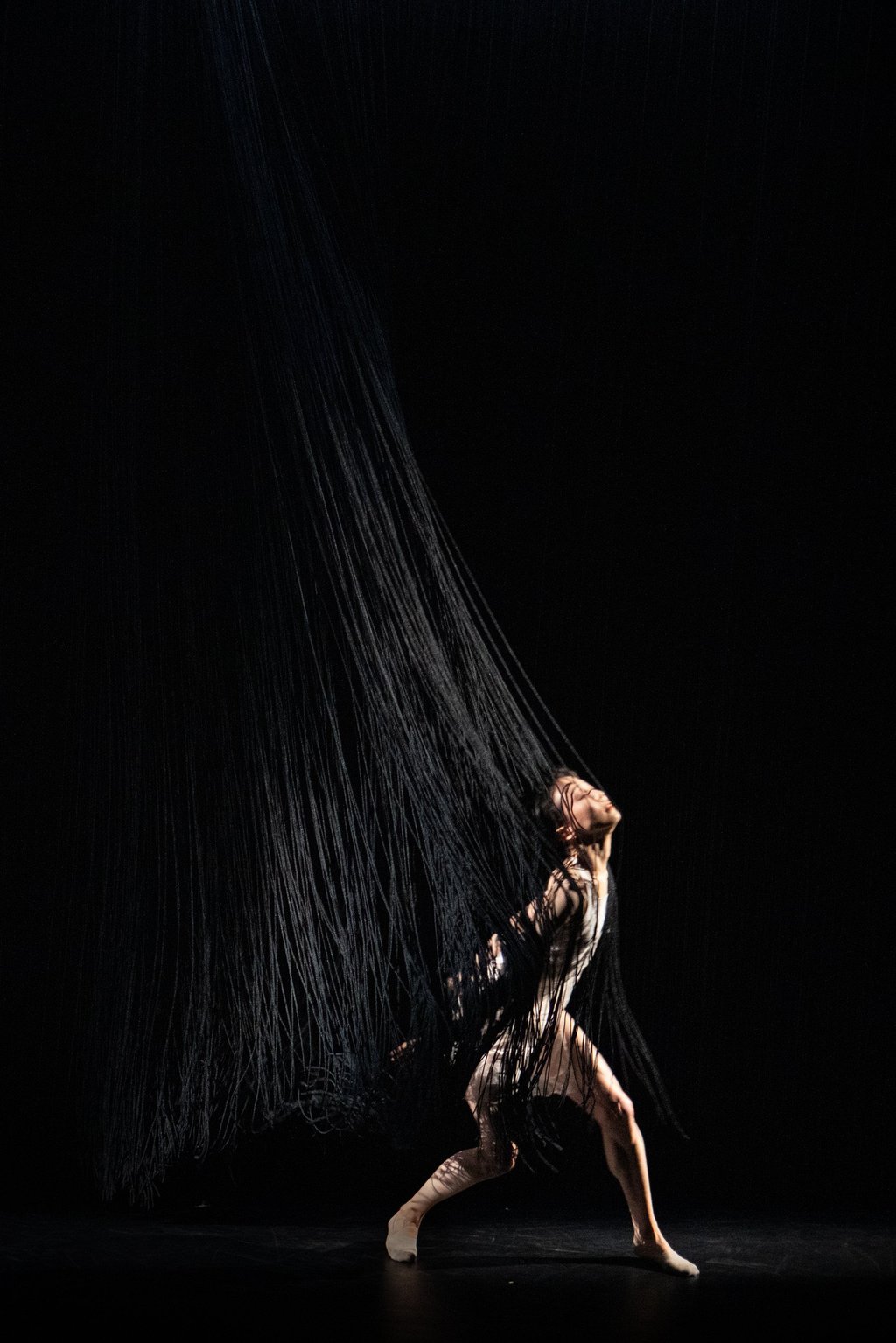
In Japan, the production featured celebrated ballerina Yui Yonezawa as Miss Thompson. For the shows at the New Vision Arts Festival, Zhang Yutong, a dancer from the Hong Kong Academy for Performing Arts, has been selected to take up the role.
Suzuki says of the choice: “Yutong has been doing Chinese dance, and she is studying female psychology. The role was originally designed with Yui in mind, and I was looking for another classically trained dancer. But after seeing Yutong dance, I wanted to see her version of Miss Thompson.”
Rain also features an original score by Japanese musician and sound artist Evala. It will be presented from November 10 to 12 in the Studio Theatre at the Hong Kong Cultural Centre.
Another dance show being showcased at the New Vision Arts Festival is Ink, created by internationally acclaimed Greek choreographer Dimitris Papaioannou and which also marks his return to the stage as a dancer after a decade.
Actual water plays a major role in this two-person performance, with a sprinkler soaking the stage as Papaioannou, dressed in all black, faces off in a duel of movement against a nude figure, performed by German dancer Šuka Horn.
Papaioannou says the show was born out of questions about human desires. “The love we desire, are we able to take it when it comes? Or do we destroy it when it comes?” he adds. “Is desire a monster that feeds upon its non-fulfilment? Are we really looking for peace of mind, or are we looking to always be thirsty?”
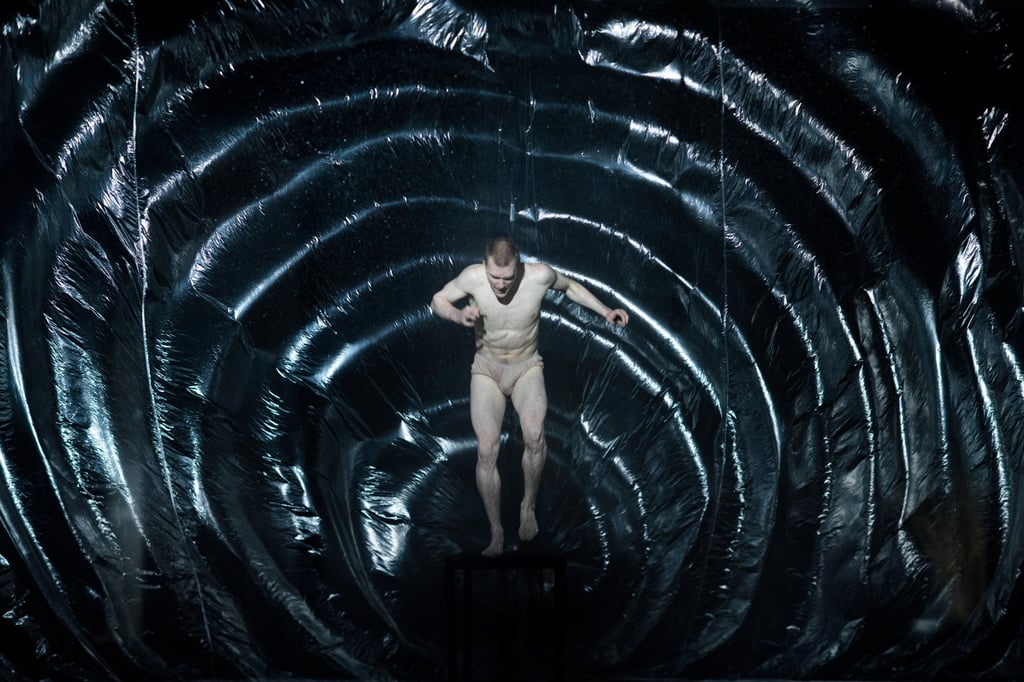
Ink is full of the symbolism and striking visuals that the choreographer is known for. In one scene, Papaioannou struggles to trap Horn behind a transparent acrylic sheet on the dark, bare stage. In another, he uses a rope to slowly pull the nude dancer, who is covered up by an octopus, towards him across the flooded floor.
“I’ve always had a childhood memory of those fishermen in the Mediterranean, when they captured an octopus and they had to kill it. They have to throw it on the rock before cooking it so that it becomes tender,” Papaioannou explains.
“This has always been done by young fishermen under the sun, and there was a repetition of violence to it. But there was also something sexual about this repetition. And there is this alien quality to this creature and the way it rests on the human body. It is a creature that is like a sexual nightmare before we understand it and its wisdom.”
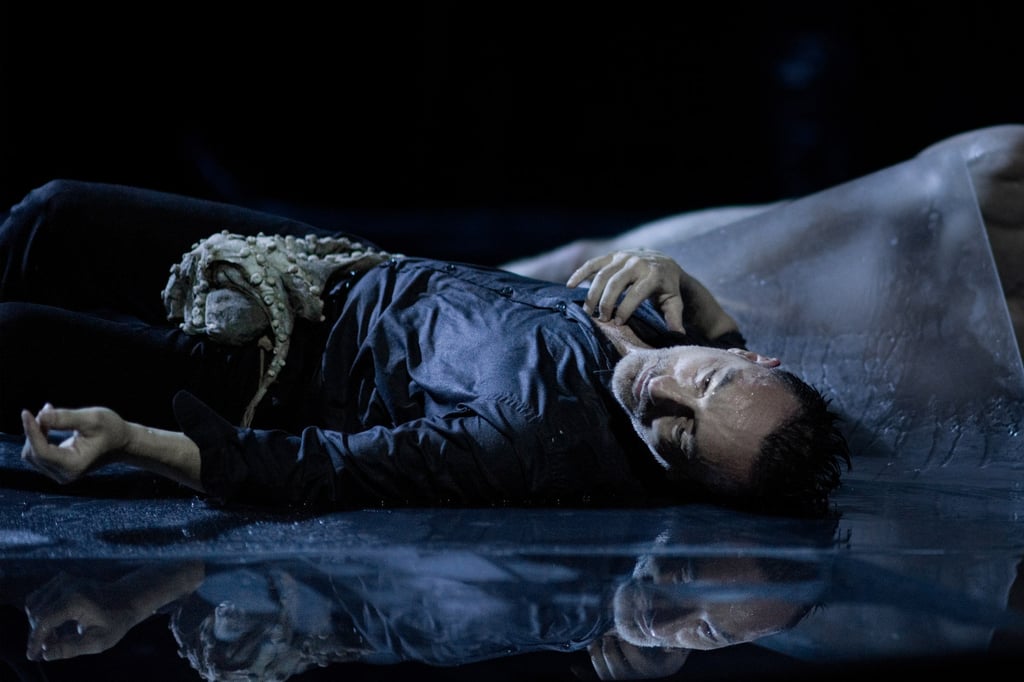
Papaioannou notes that he and Horn represent two opposites, which fuels the tension in the performance.
“Šuka is mainly a body, and he is very young and more innocent. I am mainly a mind – I am much older and much less innocent. I am alone in the underworld, trying to make things function like an artist in a workshop,” he says in describing both roles.
“And he’s someone that came into my life with all the physical energy, and is growing up and maturing through his interaction with me. There’s a certain kind of truth that is reflected in a very twisted way, of course, in the actual relationship of the characters.”
Ink will be presented from November 9 to 11 in the Grand Theatre at the Hong Kong Cultural Centre.