Hi-tech hologram steps out as Macedonian folk music gets a Cantopop makeover
Leading artists from more than 30 countries and regions worldwide perform as Hong Kong’s Asia+ Festival 2025 celebrates cultural diversity

Cutting-edge technology allows a hologram of Hong Kong dancer and choreographer Zelia ZZ Tan to step out alongside real performers while Macedonian folk music gets a Cantopop makeover at Hong Kong’s Asia+ Festival 2025.
The world premiere of the dance production Strangely Familiar – which invites the audience to reflect on what it means to coexist across different cultures – and the East-meets-West musical mash-up performed by quintet Makedonissimo are just two of the highlights at this year’s event.
The annual festival celebrates the cultural diversity of the region, particularly those countries linked by the Belt and Road Initiative – China’s plan to develop a global trading network.
This year’s third edition, presented by the city’s Culture, Sports and Tourism Bureau and organised by the Leisure and Cultural Services Department, runs from now until November 30 and features artists from more than 30 countries and regions around the world in over 100 stage productions, dance performances, concerts and other presentations.
The dance show Strangely Familiar, which was co-commissioned by Asia+ Festival and the Singapore International Festival of Arts and is being performed at The Turns, East Kowloon Cultural Centre, on November 28, 29 and 30, features performers from Hong Kong, Singapore, Macau and Malaysia.
It has been directed by Kuik Swee Boon, the main choreographer and artistic director of Singapore’s The Human Expression (T.H.E) Dance Company, and attempts to break down boundaries between cultures, identities and realities.
Kuik says the piece, featuring a holographic projection of Tan, aims to get the audience thinking about how technology can both connect people and make them feel isolated at the same time.
The dance’s distinctive, thought-provoking element evolved from deep, profound thoughts that he had surrounding the growing use of technology and artificial intelligence (AI).
“I’ve always believed that technology, at its core, is meant to bring people closer together,” Kuik says. “Yet, we seem to be living in an environment today that feels more romantic, self-focused and, at times, dark. So it makes me wonder if this is just a temporary phase, or if it’s a reflection of our deeper human nature?
“Should we be using what we see today as an opportunity to grow into a better version of ourselves? Or will the rapid rise of technology and AI replace us altogether? I thought this is important and it’s interesting for me.”
Kuik wants the dance to get the audience thinking about man’s relationship with technology on a deeper level. “I think AI, in many ways, or technology today in many ways, is simply like a mirror,” he says.
“It magnifies human nature to an extreme. It’s like holding a mirror over our civilisation and what we are doing. And so that made me wonder, are we missing something fundamental in these bigger pictures?”
The unique idea to include Tan as a hologram and avatar in the piece was a way for Kuik to convince the audience – and himself – that humans can still exist alongside technology. “To prove to myself, as much as to others, that we still can coexist,” he says. “Coexistence still is possible. And humanity still holds value in an AI-driven future.”
Tan says that performing in synchronisation with a cast, albeit in a virtual form, took her some time to adjust and adapt.
“It was definitely challenging because [as a dancer, you rely on] perceptions such as smell, touch and listening [when you are on stage],” she says. “So even if I’m not looking at that person, I can feel their presence.
“In the beginning, [it] felt so weird. I’m solo, but I need to imagine they are in the same space with me in a virtual setting, so we can feel that interaction.”
While it was challenging at first, Tan says she also gained a fresh perspective as a dancer from the experience. “That was something I found amazing, that even though we are different entities, we can [still work together on the] choreography.”
She was pleasantly surprised that even though there are more restrictions on her dance movements when performing as a hologram and avatar, there is greater flexibility to express the emotions of Strangely Familiar in other ways.
“We become one connected network to share the vision, rather than being restricted by the steps,” she says “[As] a hologram, I cannot move that crazily, I need to slow down. But in the choreography, the synchronisation of the breath and the timing and energy exchange are being coded or organically grown through the process of rehearsal practice.”
Despite the focus on technology in Strangely Familiar, Kuik found solace in the fact that human ingenuity was still needed to create the holographic projection.
“The hologram and avatar and all the other technology that goes into it, it is [created] with the help of technology,” he says. “But at the start of it, there’s still a human brain, human creativity, putting thought, care and consideration into designing a methodology that you can then use.
“It is also another message that I want to convey – that technology is great and amazing but at the end of the day, it is not a substitute for the human brain and human creativity.”
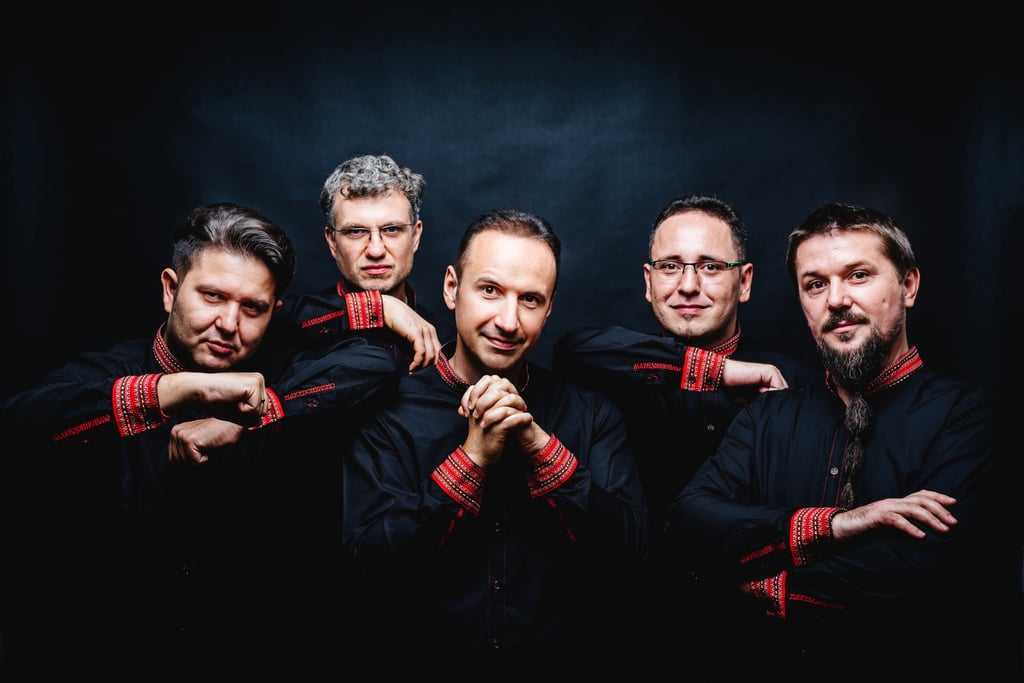
The festival offers another intriguing performance on October 21 at Hong Kong City Hall that blends traditional Macedonian folk songs with influences of jazz, Chinese music – and Cantopop.
The quintet of musicians who make up Makedonissimo, led by pianist Simon Trpčeski, will play their signature blend of emotional and exuberant folk music with jazz and classical elements. Later, they will perform a specially created segment featuring traditional Macedonian tunes, Cantopop and Chinese music alongside Hong Kong Chinese Orchestra’s suona (trumpet-like) principal Ma Wai-him and (stringed) huqin player Chan Pik-sum, with Hong Kong Cantopop composer Johnny Yim arranging two medleys for the segment.
The idea for the collaboration came about from conversations between Trpčeski and the Asia+ Festival organisers.
“As an ensemble, we are open to embracing the world with the music,” he says. “So I suggested that we can make a blend and collaborate with local artists, local tunes. Because this was the idea also of the [Makedonissimo] project. And we have absolutely shown respect to many different people from many different cultures, wherever we went. And we saw the reaction and we can see the power of the music.”
The other members of the quintet are Hidan Mamudov on clarinet, alto saxophone and kaval (a traditional Balkan flute), the violinist Aleksandar Krapovski, cellist Alexander Somov and percussionist Vlatko Nushev.
Even though Macedonian folk music, Cantopop and traditional Chinese music and instruments may not initially seem to share many similarities, music has the power to cross boundaries and passionate musicians, including members of Makedonissimo, are eager to explore new forms and put their own twist on it.

Nushev, for example, performed with some traditional Korean percussion instruments when the group took part in the Music at PyeongChang classical music festival in South Korea.
Krapovski says he sees similarities between the violin and Chinese stringed instruments. “Music is universal so we always find bridges between [Asia] and Southeastern parts of Europe,” he says. “And there are certain intonations and things that we actually find in common as well.”
Mamudov adds: “In our Balkan music, there is actually a lot of Oriental influence.”
Somov, who is originally from Bulgaria, says he finds adapting to different types of music as a member of Makedonissimo to be an enriching experience.
“We are all classically trained but we are also exploring different techniques; we are exploring different approaches to the music,” he says. “Whether it be with [instruments] we wouldn’t usually use or techniques that we wouldn’t usually use in our classical performance. It’s like learning a new language and it can be very meaningful.”
Trpčeski says Macedonian folk music is emotional and can be seen as a symbol of life. “This is music that connects people, brings people together. It is music that is used at people’s gatherings, at people’s weddings,” he says. “So there is a lot of love, a lot of sorrow, a lot of passion, a lot of happiness also.”
Makedonissimo gives folk music the classical treatment at the hands of the five musicians, with Trpčeski calling it “highly sophisticated chamber music”.
“And with the universal language of music, it’s quite a unique and effective way to showcase Macedonian culture to people in Hong Kong. And to make the world a little bit smaller through the concert,” he says.