How one university uses AI to prepare students for their future careers
Xi’an Jiaotong-Liverpool University’s ‘syntegrative education’ equips students with practical leadership skills and entrepreneurial mindset

The growing use of data and technologies such as artificial intelligence (AI) – computer systems that can copy intelligent human behaviour – has enabled companies to offer their customers more individualised products and services, which have transformed many different parts of people’s everyday lives.
Personalised learning – a student-focused educational approach that tailors the instruction based on an individual’s strengths, interests and goals – is also becoming increasingly popular with universities worldwide.
Educational institutions that have adopted personalised learning have reported positive outcomes including improved student engagement and academic results.
One place that fully embraces personalised learning and has introduced the use of AI in its classes is Xi’an Jiaotong-Liverpool University (XJTLU), an international joint-venture university in Suzhou, in eastern China’s Jiangsu province, founded by Xi’an Jiaotong University in China and the University of Liverpool in the United Kingdom.
The university, which was established in 2006 and celebrates its 20th anniversary next year, is based at two campuses in Suzhou Industrial Park and Taicang, a county-level city about an hour’s drive northeast of Suzhou.
It offers more than 100 degree programmes in the fields of science, engineering, business, finance, architecture, urban planning, language and culture, with all of them taught in English.
It introduced its “syntegrative education” strategy in the 2016-17 academic year – in response to evolving technological, industrial and societal needs – which aims to equip students with practical leadership skills and an entrepreneurial mindset to meet the demands of their careers.
Professor Xiaojun Zhang, the university’s chief officer of education, says this approach is the key to nurturing future leaders who can navigate a dynamic world as various industries and sectors undergo fundamental changes because of the use of emerging technologies such as AI.
“Syntegrative education is a cross-disciplinary approach designed to help students gain a full understanding of the core issues of an industry,” he says. “Besides the foundational technical knowledge, we define our curriculum and courses based on issues involving management, innovation, policy and the future development of the industry.
“Students will also take courses where they learn about effective leadership and communication skills, which are essential for their future careers and also an important part of our integrated educational model.”
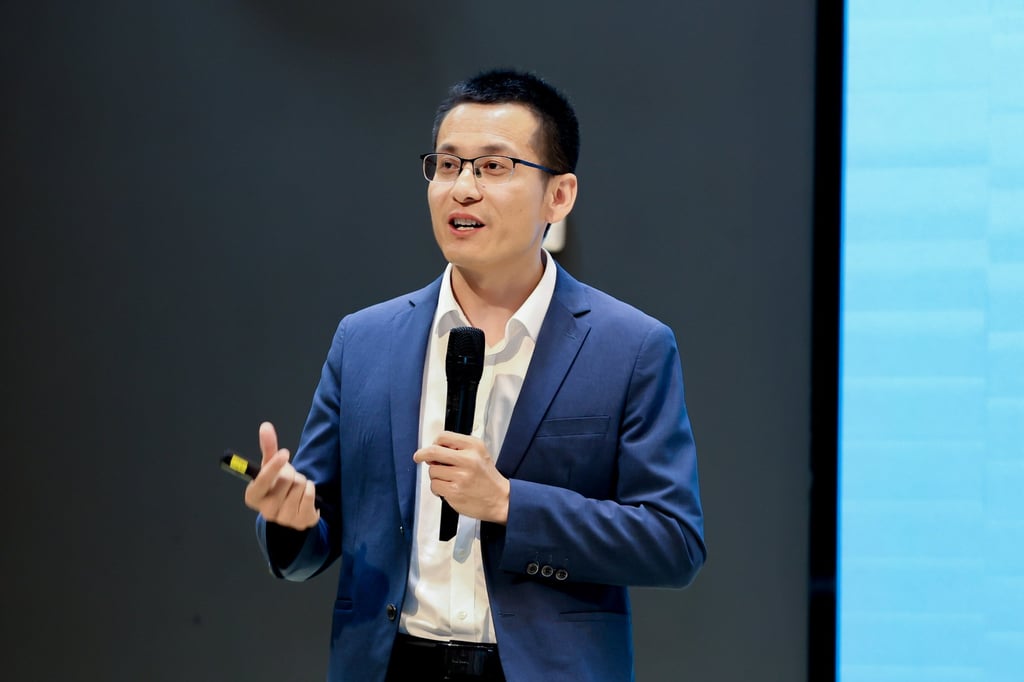
Zhang is based at the university’s Taicang campus, which houses the XJTLU Entrepreneur College, which includes a range of dedicated schools, including those of AI and Advanced Computing, Intelligent Finance and Business, and Internet of Things – the connection of devices within everyday objects via the internet, which enables them to share data.
He believes that syntegrative education and personalised learning go hand in hand. Both concepts are centred around guiding students to find their own interests, which he says is important for their future success.
“During the first and second years, we offer students many opportunities to work on projects for – and engage with – real-world companies and immerse them in social and business scenarios,” he says.
“These experiences help them not only build transferable skills such as problem solving, but also give them opportunities to experience various industries first-hand, which allows them to develop their passion for topics and fields that interest them.”
Starting from September, all of the Year Two students at the college are required to take a mandatory “syntegrative project” course, where the university and partner companies have identified dozens of real-world problems faced by these organisations, for which students are asked to propose solutions.
One such project is for Charoen Pokphand Group, a Thai conglomerate behind one of the world’s largest producers of food and agricultural products. Students have been tasked with creating a proposal for an AI-powered solution that could help to refine its supply-chain network to more accurately estimate the optimal stock level for each of the group’s outlets to better meet customer demand.
“Students from different disciplines can team up and apply what they have learned to the proposals for their client,” Zhang says. “In addition to gaining the experience of executing a project from the start – from understanding the problem and research, to analysing their findings and testing their solutions, to presenting their final proposal – syntegrative projects are meant to foster the spirit of cross-disciplinary collaboration, too.”
To further foster students’ innovative spirit, the college also offers a programme called Innovation Factory, a platform which gives them access to the university’s laboratories and resources to facilitate prototyping and product development projects.
Meanwhile, its X3 Co-venture programme aims to guide students through the launch of their own start-up, from experimentation and project incubation to acceleration, and connect them with investors and resources to launch their project.
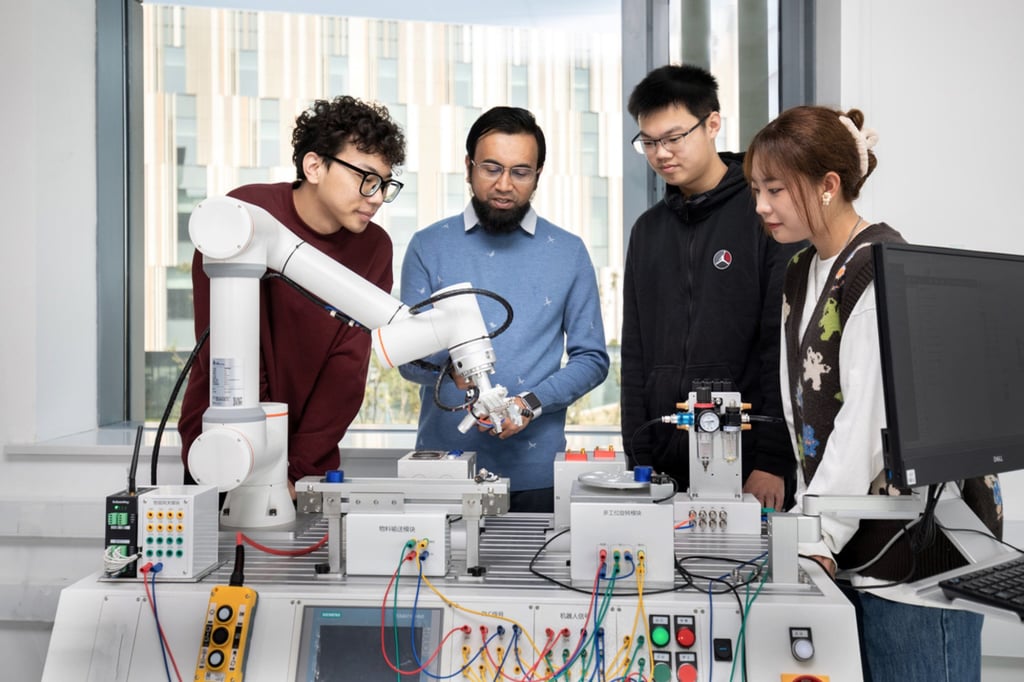
Syntegrative education also refers to the university’s approach to addressing the opportunities created by the growing popularity of AI.
Earlier this year, it released the “Education + AI Strategic Framework 2025-2028” – its three-year plan to harness the potential of AI and to enhance innovation and research, as well as to boost its status as an AI-empowered institution.
The university offers a range of AI courses including bachelor’s degrees in digital and intelligent marketing, electronic science and technology, and data science and big data technology with contemporary entrepreneurism, and master’s degrees in AI, advanced robotics systems, and intelligent engineering science and industrial operations.
It also actively encourages students and staff to incorporate the technology into their everyday learning routines. Every university course also has an AI agent which helps support the learning experience.
All the AI-powered tools and materials are available on the university’s Learning Mall, an online learning platform which also has analytical capabilities to keep track of students’ progress and offer feedback.
The platform also acts as a virtual hub for entrepreneurial research and a development hub for knowledge exchange where the university and its global partners – including the Massachusetts Institute of Technology in the United States, and companies Apple, Microsoft and Huawei Technologies – can share learning content and resources with users.
Content on the platform has been made available to the public since 2021, as have course materials for classes offered at the college since earlier this year.
“Making these materials available to everyone is a decision that echoes the university’s philosophy of treating learning as a lifelong pursuit,” Zhang says. “This passion for learning should be supported and encouraged for everyone in society regardless of their age and background to better support evolving societal needs.”