Advertisement
China’s Communist Party
ChinaPolitics

Fringe view of China’s history sparks official rebuke after going viral online

Oversimplified discourse on Ming, Qing dynasties risks slide into ‘narrow, Han-centric nationalism’, Zhejiang authorities warn

Reading Time:5 minutes
Why you can trust SCMP
4
The “1644 perspective” that frames the Ming dynasty as a golden age of prosperity and advancement has been widely shared on China’s social media. Photo: Handout
Meredith Chenin Hong KongandPhoebe Zhangin Shenzhen
A wave of online discussion blaming China’s last imperial dynasty for national historical sufferings has prompted official criticism after touching on sensitive questions, and ignited debate over historical narrative, nationalism and social governance.

What began as a fringe literary interpretation of an 18th-century classical novel has evolved in recent weeks to become a viral internet topic, known as the “1644 historical perspective”.
The main claim – which has exposed sharp divisions online – is that China was prosperous and powerful under the Ming dynasty, which was ethnically Han, and its decline began with the Manchu conquest that established Qing rule in 1644.
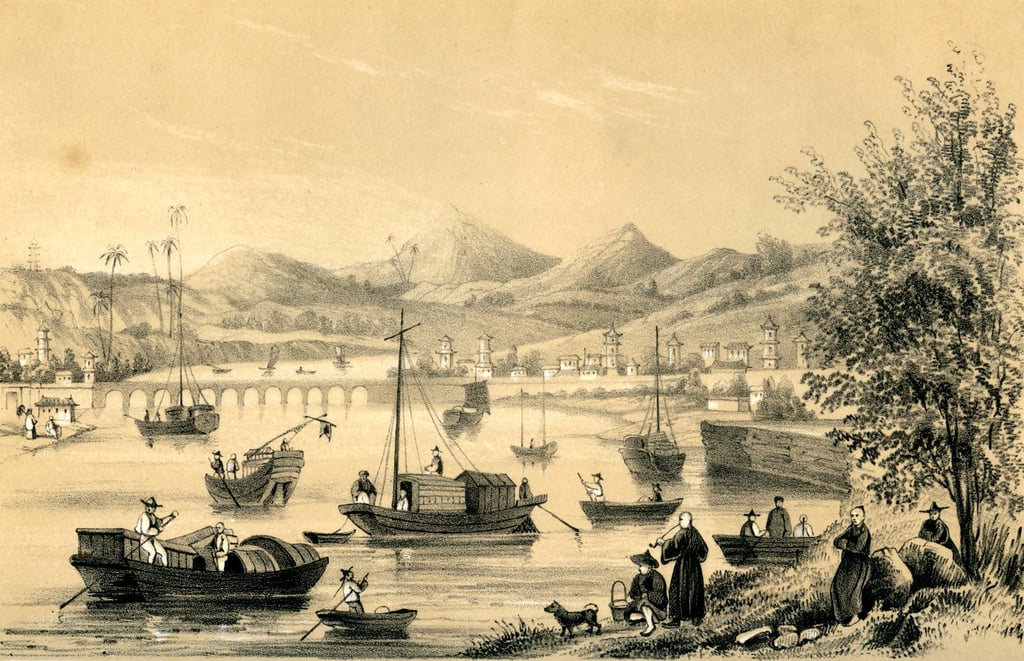
The Treaty of Nanking in 1842, after the first opium war, established five treaty ports in China. Photo: Getty Images

Last Wednesday, the Zhejiang provincial propaganda department published an article on its social media account that said the framing of the Manchu invasion and fall of the Ming dynasty as “an interruption of Chinese civilisation” was misleading.

Advertisement
By framing the Qing dynasty as a foreign colonial regime, the discourse undermined the resilience of Chinese civilisation, oversimplified the causes of the Ming dynasty’s collapse and risked a slide into narrow, Han-centric nationalism, it said.

“More concerningly, the so-called 1644 interpretation of history echoes certain overseas narratives aimed at deconstructing China’s historical continuity, providing rhetorical ammunition for arguments that seek to deny the historical legitimacy of China as a unified, multi-ethnic nation.”

Advertisement

The role of the Qing dynasty – which ended with the last emperor’s abdication in 1912 – in shaping the country’s territorial and ethnic framework, as well as solidifying the notion of China as a stable, unified concept, has made its history thorny and politically sensitive.

Advertisement
Select Voice
Choose your listening speed
Get through articles 2x faster
1.25x
250 WPM
Slow
Average
Fast
1.25x