Advertisement
Chinese physicists prove Einstein wrong and put century-old debate to an end
‘Exceptionally precise’ set-up mimics thought experiment devised by sceptical genius to disprove the then-emerging field
Reading Time:3 minutes
Why you can trust SCMP
27

Ling Xinin Ohio
For the first time, scientists in China have faithfully recreated a thought experiment proposed by Albert Einstein nearly a century ago, showing that the quantum world behaves in ways the iconic physicist never fully accepted.
Pan Jianwei – known as the country’s “father of quantum” – and his team at the University of Science and Technology of China built a device sensitive enough to register the tiny push of a single photon.
Einstein laid out a modified version of the famous double-slit experiment at the historic 1927 Solvay Conference in Brussels, hoping it would disprove Bohr’s view that a particle’s path and its wavelike interference pattern could not be observed at the same time.
Advertisement
Bohr believed this was not a technical limitation but a fundamental rule of nature. Einstein disagreed.
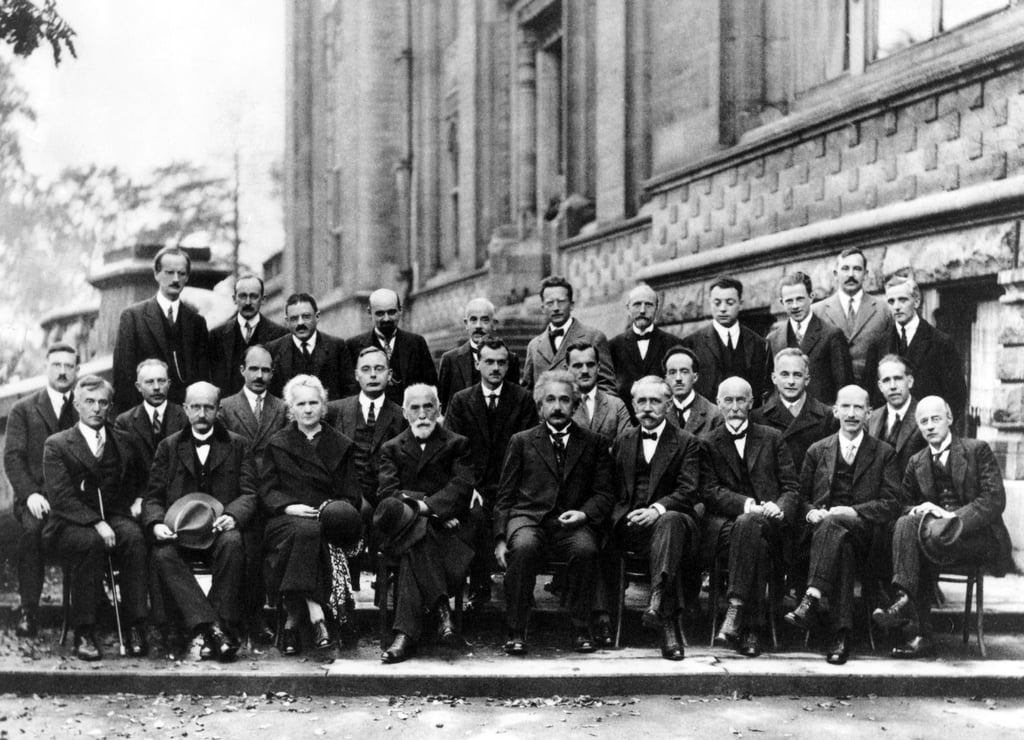
In a paper published on Wednesday in Physical Review Letters, the researchers confirmed Bohr’s thinking that both properties cannot be observed at once – a principle that defines the limits of human knowledge.
Advertisement
Advertisement
Select Voice
Choose your listening speed
Get through articles 2x faster
1.25x
250 WPM
Slow
Average
Fast
1.25x