Advertisement
Hong Kong politics
OpinionHong Kong Opinion
Bernard Chan

Opinion | How fear became a tool of manipulation, not just in Hong Kong

Without truth and transparency, fear can become a debilitating political tool that stifles opportunity and progress for everyone

Reading Time:3 minutes
Why you can trust SCMP
2
A child reacts as Kuomintang  party supporters rally against a recall election in Taipei on July 25. Photo: Reuters

Fear is a powerful emotion with a profound capacity to influence not only individual choices but also the direction of national and global policies. In today’s polarised world, fear is no longer just a spontaneous reaction; it has become a deliberately used tool to influence public opinion, guide behaviour and shape narratives.

This intentional use of fear has wide-reaching consequences, such as subtle changes to societal perceptions. From headlines warning of conflict over Taiwan to data privacy advocates recommending the use of burner phones when visiting the US, fear has significantly influenced how we respond to uncertainty.
The 2019 protests in Hong Kong, for example, were triggered by opposition spreading fear about the proposed extradition law. Critics argued that the law would allow authorities to arrest anyone they wished, even extraditing them to mainland China. This fear sparked widespread distrust, with many believing the law would undermine Hong Kong’s autonomy and judicial independence. These concerns were heightened by constant media coverage and social media echo chambers, which mobilised millions and deepened the public’s mistrust of government motives.
Advertisement

Many foreign media outlets, often adopting a sensationalist tone, speculated on the broader implications of these events. Meanwhile, social media platforms allowed for a distortion of perceptions by fostering insular environments where users primarily encountered content that reinforced their fears. This cycle of fear has eroded trust and undermined rational discourse.

Western companies reportedly responded to these fears by advising executives to use burner phones when visiting Hong Kong. Despite the lack of conclusive evidence suggesting the need for such measures, perceived risks alone shifted travel behaviour and deterred people from visiting the city. This shows how fear, even when unsupported by factual evidence, shapes decisions and disrupts normalcy.
Advertisement
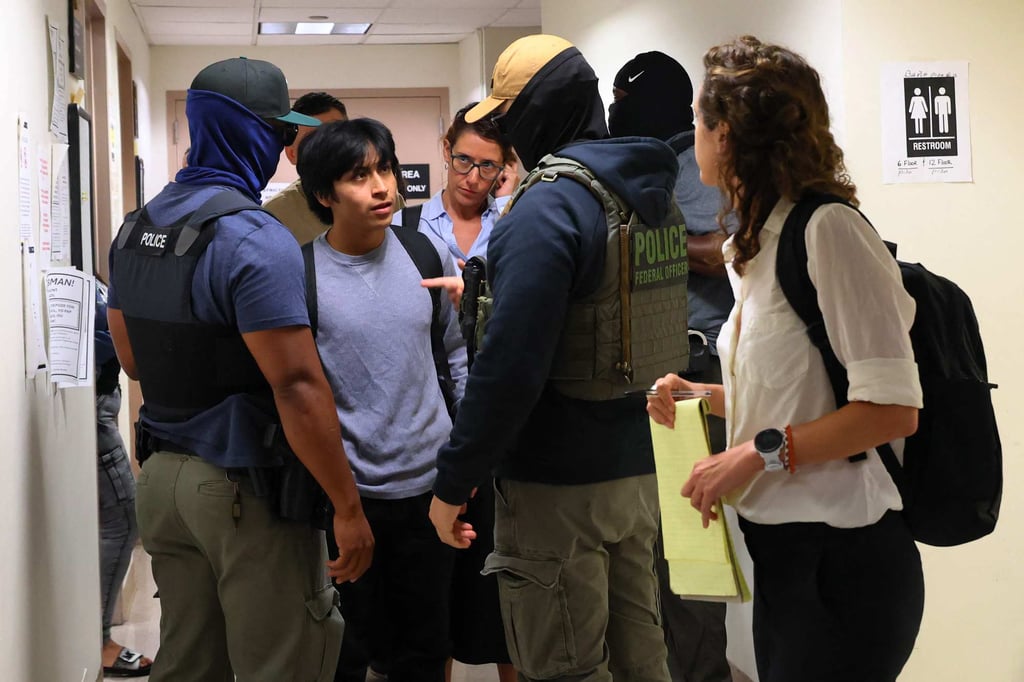
Ironically, concerns about privacy and government oversight are now impacting the United States, with reports of border officials searching electronic devices and scrutinising inbound travellers’ social media profiles. Additionally, Immigration and Customs Enforcement’s targeting of undocumented immigrants has created a climate of fear that disproportionately affects ethnic minorities and immigrants, fostering insecurity instead of trust.
Federal agents detain a person exiting an immigration court hearing in New York City on August 6. Photo: Getty Images/AFP
Advertisement
Select Voice
Choose your listening speed
Get through articles 2x faster
1.25x
250 WPM
Slow
Average
Fast
1.25x