Dan Flavin’s luminous legacy shines in Hong Kong’s first solo exhibition
The American artist’s minimalist light grids debut in Hong Kong, showcasing Flavin’s pioneering use of fluorescent lamps

Thirty years after his death, Dan Flavin’s radiant works have finally arrived in Hong Kong for the artist’s first solo exhibition in China. Running until August 8, at David Zwirner’s space in H Queen’s, the show features the late American artist’s illuminated grids, a key theme in his work.
Regarded as one of the founders of minimalist art, Flavin was famed for his sculptures and installations created from fluorescent-light fixtures. The exhibition features recreations of his grid installations at significant showcases and contains loans from important public collections as well as Flavin’s estate. The presentation comes straight from New York, where David Zwirner showcased the works earlier this year.
Flavin described his installations not as objects, but as “situations” of light and colour. He began experimenting with light in the early 1960s, with works such as the diagonal of May 25, 1963 (to Constantin Brancusi) (1963) – a single gold fluorescent lamp installed diagonally on a wall. We did say he was a minimalist, after all.
Working exclusively with commercially available fluorescent lamps until his death in 1996, Flavin developed a body of work notable for both its consistency and its evolution. From solitary diagonals and geometric corners, his practice eventually culminated in the grid: monumental arrangements of coloured light.
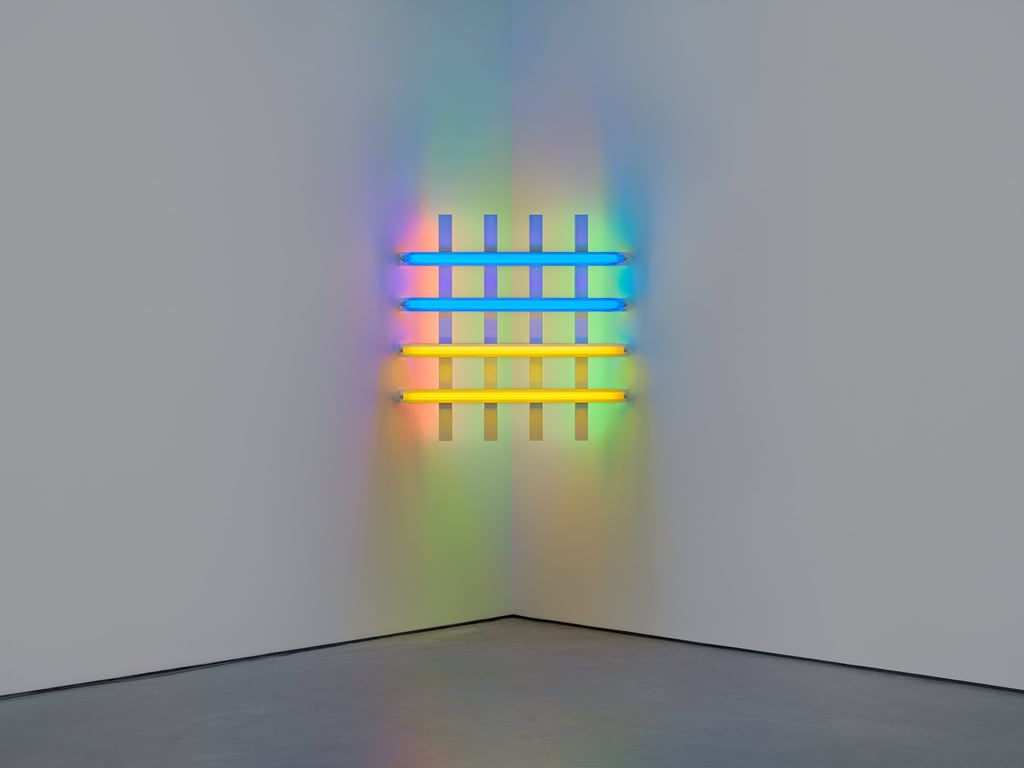
It is in the grid that Flavin found the perfect combination for the interplay of light he sought. “[The grid has] a rich contrast, front over rear, and an optical interplay […] all modified by reflected colour mixes and shadows of the grid structure itself,” Flavin wrote in a 1978 letter to Thomas Armstrong, the then-director of the Whitney Museum of American Art, New York, who was in the process of acquiring a grid for the museum’s collection. “As an ensemble, this intense fluorescent light use/abuse seems to me to be rare in my production. And I commend it all to you.”