Advertisement
Australia
This Week in AsiaEconomics

Aukus faces an ‘America first’ review. Will Trump’s agenda scupper the deal?

Australia’s huge financial commitment to the Aukus pact may work in its favour, but Trump’s deal-making approach means anything is possible

Reading Time:3 minutes
Why you can trust SCMP
18
US Navy officers stand aboard a Virginia-class fast-attack submarine docked at HMAS Stirling in Western Australia on February 26. Australia is set to spend US$7.9 billion to upgrade shipyard facilities for a future fleet of nuclear-powered submarines. Photo: AFP
Maria Siow
A sweeping review by the United States of the landmark Aukus submarine pact could usher in stricter conditions on technology transfers, cost-sharing and fresh concessions from Australia, raising questions about the future of the trilateral deal.
US Secretary of State Marco Rubio had privately assured Australian Deputy Prime Minister Richard Marles that the pact would not be terminated, The Washington Post reported earlier this month, citing sources familiar with the discussions.

The Aukus agreement, unveiled in 2021 by Australia, Britain and the United States to counter China’s expanding naval influence, would enable Canberra to acquire at least eight nuclear-powered Virginia-class submarines from the 2030s.

Advertisement

Valued at US$240 billion, the deal would elevate Australia into the select ranks of nations with nuclear-powered underwater strike capability.
Washington launched a review of Aukus in June, seeking to ensure its alignment with US President Donald Trump’s “America first” agenda, prompting concerns that his administration might abandon or significantly alter the deal.
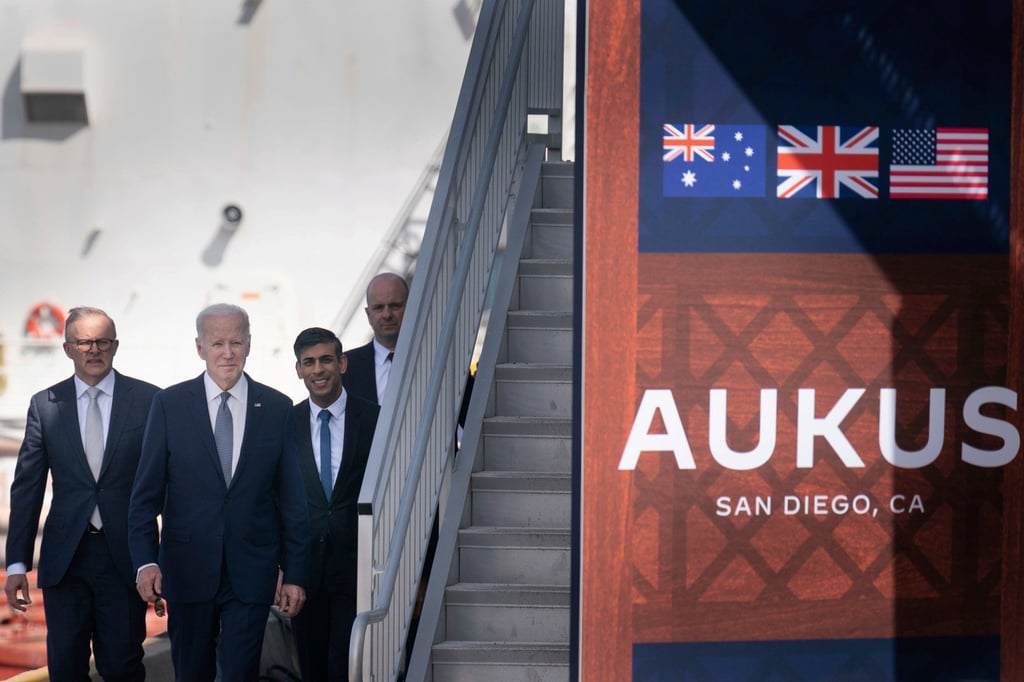
(From left) Australia’s Prime Minister Anthony Albanese is joined by then US president Joe Biden and former British prime minister Rishi Sunak at an Aukus event in 2023. Photo: AP

But Rubio’s assurances suggest the review is more likely to result in recalibration – including tighter safeguards on technology transfer and cost-sharing – than outright cancellation, according to Troy Lee-Brown, a research fellow at the University of Western Australia’s Defence and Security Institute.

Advertisement
Select Voice
Choose your listening speed
Get through articles 2x faster
1.25x
250 WPM
Slow
Average
Fast
1.25x