Advertisement
Malaysia
This Week in AsiaOpinion
Liew Chin Tong

Asian Angle | Malaysia’s two emergencies: why 2021’s freeze on democracy is not like the trouble of 1969

  • PM Muhyiddin now has unfettered powers after calling a state of emergency as Covid-19 cases surge, the first time a national one has been declared since racial riots in 1969
  • Critics say the move is that of an embattled leader trying to cling on to power, but there is hope: voters will not tolerate a return to authoritarian rule

Reading Time:4 minutes
Why you can trust SCMP
2
Deserted roads in Kuala Lumpur after a lockdown and state of emergency were imposed to curb the spread of Covid-19. Photo: Reuters
Amid soaring Covid-19 cases, the prolonged political crisis in Malaysia since a parliamentary coup in February last year came to a head on Tuesday when a state of national emergency was declared for the first time since 1969. At the time, parliament was suspended after racial riots broke out between Malays and Chinese in Kuala Lumpur, leaving almost 200 people dead. It only reconvened in 1971.
Under a state of emergency, Prime Minister Muhyiddin Yassin and his cabinet now have powers to make laws without parliamentary approval. This essentially means Malaysia’s rendezvous with democracy – which only began with the May 2018 election that brought down the only ruling coalition the country had known since its independence in 1957 – is now fully frozen. So what’s next?

The irony is that the massive increase of Covid-19 cases provided an excuse for Muhyiddin to amass unfettered executive powers without having to be accountable to parliament.

The emergency was declared in the name of a rapidly worsening health crisis, which can be very much attributed to the third wave of infections since September as a result of the huge numbers of people travelling during the Sabah state election. Up until August, Malaysia had more or less flattened the Covid-19 curve.

Advertisement
The United Malays National Organisation (Umno)-Barisan Nasional regime under former prime minister Najib Razak was defeated in the 2018 general election very much because all of Najib’s enemies – particularly Mahathir Mohamad and opposition prime minister Anwar Ibrahim, nemeses since their falling out in 1998 – had a detente and formed a grand coalition.

But that Pakatan Harapan government was inherently unstable due to the rivalries between Mahathir and Anwar, and in each of their respective parties there was a subplot – Muhyiddin, at the time home affairs minister, was unhappy with Mahathir’s rule, while Anwar had an estranged relationship with his erstwhile protégé Azmin Ali.
Advertisement
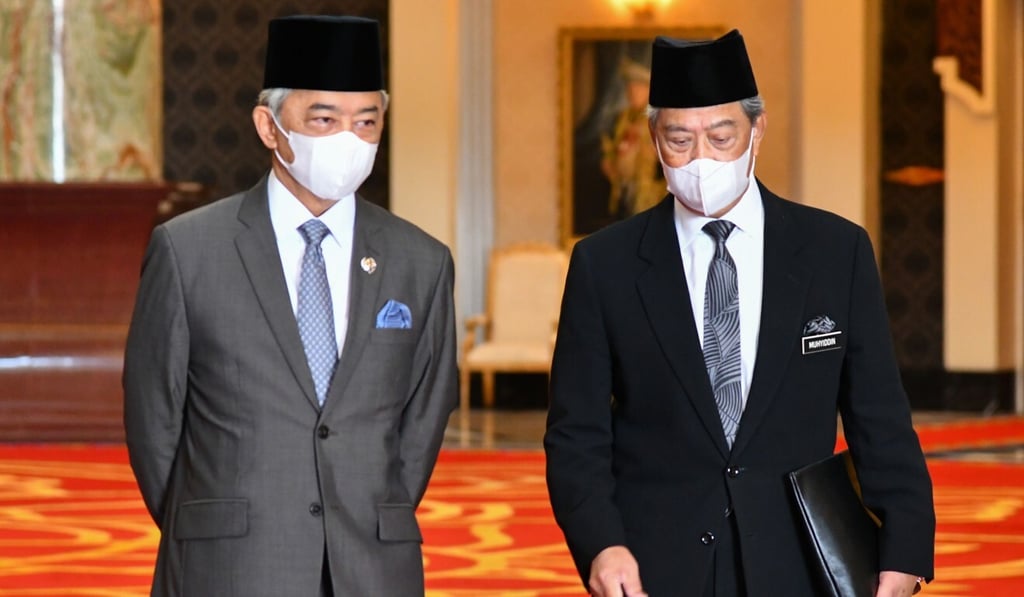
Malaysia’s Prime Minister Muhyiddin Yassin (right) and the country’s king, Sultan Abdullah Sultan Ahmad Shah, at the National Palace in Kuala Lumpur. Photo: AFP
Advertisement
Select Voice
Choose your listening speed
Get through articles 2x faster
1.25x
250 WPM
Slow
Average
Fast
1.25x