
Asian Angle | Sabah’s election proves Malaysians want results, not slogans
Local parties crying ‘Sabah First’ largely flopped as voters rejected empty identity rhetoric for proven service records

With 1.7 million voters choosing from a record 22 parties and 596 candidates, the ballot resembled a democratic marketplace: rich in options but fragmented in direction. Some see this as a recipe for instability; others interpret it as part of Sabah’s ongoing political evolution as it seeks a model distinct from neighbouring Sarawak, whose relative stability is often credited to the dominance of local parties and entrenched elites.
Yet beneath the surface of this crowded contest, the battleground coalesced around a few key rivalries. In bumiputra constituencies, Sabah People’s Coalition (GRS), Warisan, Perikatan Nasional and Barisan Nasional competed. In non-Muslim bumiputra areas, GRS, the Homeland Solidarity Party (Star), the United Progressive Kinabalu Organisation (UPKO) and the Social Democratic Harmony Party were the principal contenders. The ethnically mixed and plurality seats, where no ethnic group commands more than 60 per cent of the population, saw open contests involving all the key parties.
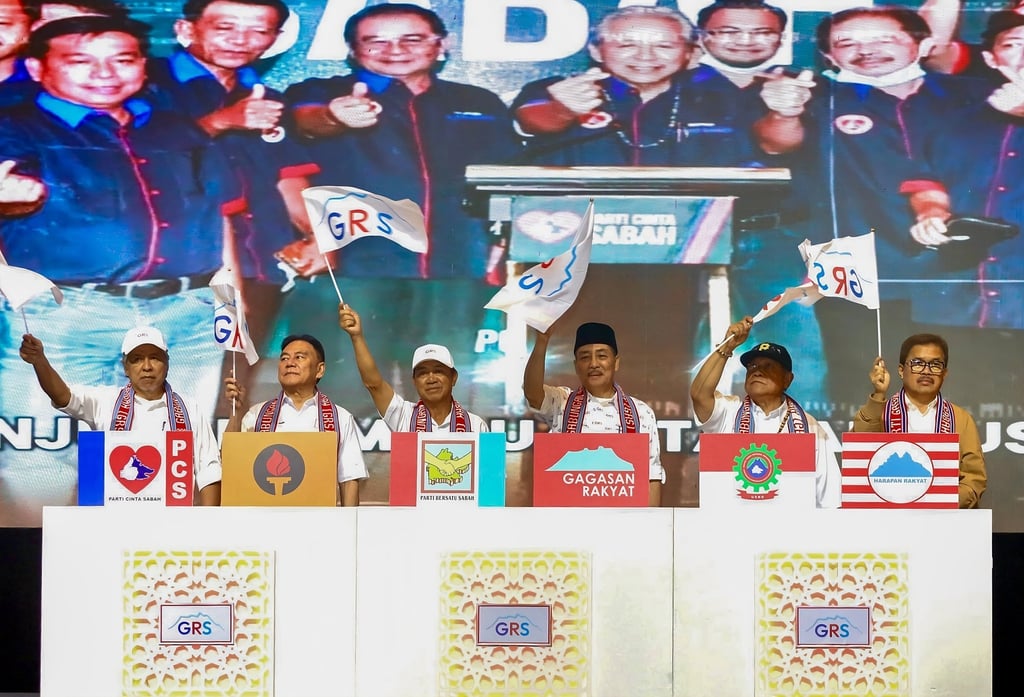
Despite internal tensions and allegations of corruption, GRS still emerged as the largest bloc, securing 29 seats. What accounted for this outcome? Was it the effectiveness of the “Sabah First” narrative, or a genuine surge in the coalition’s popularity? A closer look suggests that GRS’ success owed less to increasing voter support than to structural advantages: incumbency, vote-splitting among opponents and candidates with strong personal followings.
Notably, GRS experienced a negative vote swing in most constituencies compared to 2018 and 2020. Only four of its incumbents registered a positive net swing, with Kawang recording the highest at +11.1 per cent. This underlines a critical point: GRS won not because of widespread enthusiasm, but because it remained the best organised and most recognisable force in a splintered field. The opposition’s disarray helped GRS. In many seats, Warisan, Perikatan Nasional, Pakatan Harapan (PH), Barisan Nasional and independents split the anti-GRS vote.
PH’s weaknesses were clear: poor local leadership, parachuted-in candidates and inadequate party machinery. The coalition’s sole victor was Jamawi Jaafar in Melalap, but his success owed more to his personal brand than to PH’s appeal, as he is a well-established local leader with a strong service record. PH’s inability to convert its federal platform into local traction highlights its disconnect from Sabah’s political realities.
Still, PH’s base has not disappeared. Candidates who fail to secure at least one-eighth of the total votes cast in their constituencies forfeit their 5,000 ringgit (US$1,200) deposit. Only two of PH’s 22 candidates lost their deposits, suggesting residual support goodwill that could be revived.