Asean leaders discussed a proposal at their summit in May to develop a regional oil stockpile, prompted by the energy crisis amid the US-Israel war on Iran. This move reflects renewed efforts to foster energy security, but a review of the Association of Southeast Asian Nations’ track record offers little reason for optimism. Unless the bloc moves quickly to institutionalise and implement the idea, it risks becoming another ambition that’s quietly shelved.
Early reactions to the proposal were mixed. The Philippines and Japan have discussed joint stockpiling arrangements, both bilaterally and for Asean more broadly. Indonesia has offered to host an Asean oil storage hub. Singapore said the proposal was not yet sufficiently developed, noting that further discussion would depend on continued interest, while Malaysia flagged financial constraints. Other members’ positions remain largely speculative, with some analysts suggesting that bilateral energy deals with external partners could shape their responses.
There is a firm rationale for Asean oil reserves while also fostering an energy transition. The International Energy Agency’s 2026 Southeast Asia Energy Outlook projects the region will account for one-fifth of global energy demand growth through 2035. Southeast Asia still relies on fossil fuels for most of its power generation and is exposed to geopolitical risks with 60 per cent of its crude oil imports originating from the Middle East. Moreover, oil reserves across Asean remain inadequate and unevenly distributed: most members maintain 20 to 50 days of demand, mainly in the form of commercial stocks, according to the Economic Research Institute for Asean and East Asia (ERIA).
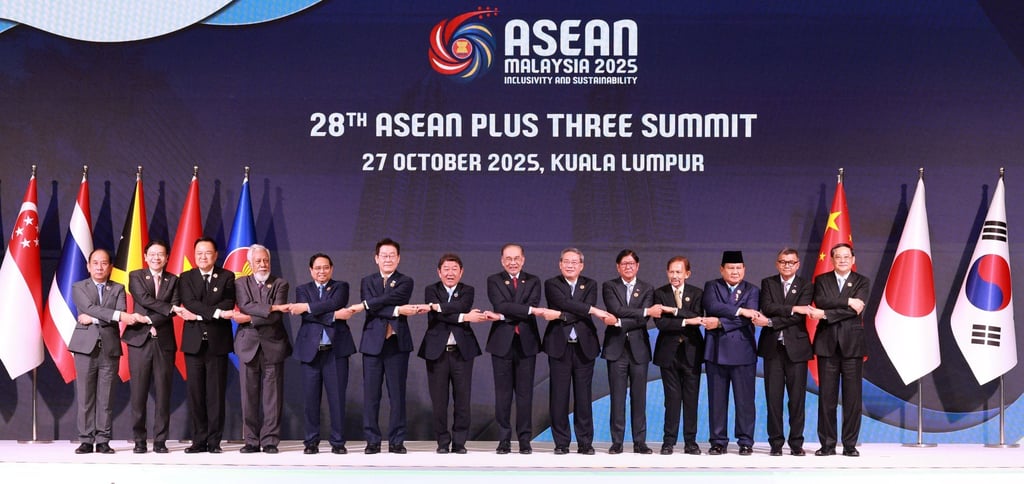
Leaders at an “Asean plus three” summit in Kuala Lumpur, Malaysia, last year. The platform has given special attention to oil stockpiling. Photo: Yonhap/EPA
A history of false starts
Regional oil stockpiling is not a new concept. The Asean Petroleum Security Agreement (APSA), signed in 1986, created a framework for an emergency oil-sharing mechanism. In response to its limitations, Asean adopted a revised APSA in 2009, which only entered into force in 2013 following Indonesia’s ratification. That agreement, which was renewed in 2025 after lapsing, specifically states that Asean members shall endeavour to develop joint oil stockpiles alongside national reserves. However, this is a voluntary framework that provides little incentive for costly collective investment in regional infrastructure, which ultimately led to inaction.
The “Asean plus three” cooperation framework, which also includes China, Japan and South Korea, is another platform that has given special attention to oil stockpiling. At its inaugural energy ministers’ meeting in 2004, then Philippine energy secretary Vincent Perez proposed the former US naval base at Subic Bay as a potential regional storage facility. A working group subsequently produced the Oil Stockpiling Roadmap, which was approved in 2010 but never resulted in an operational plan and the idea dropped off the agenda in the end.
Outside Asean mechanisms, the Asia-Pacific Economic Cooperation (Apec) forum and the Asia Cooperation Dialogue (ACD) have explored similar ground: Apec released a report on joint stockpiling options for its members in 2000 and ACD countries agreed to assess the feasibility of a similar initiative in 2004. However, neither initiative advanced beyond knowledge exchange and capacity building.
Why did previous efforts fail? Establishing and maintaining oil reserves is expensive and Asean members differ notably in their dependence on imported oil, technical standards and emergency planning. Concerns over security, governance and freeriding, plus a lack of trust, further undermine cooperation. These obstacles remain largely unaddressed today. As such, although geopolitical tensions might strengthen the case for regional reserves, there is little reason to believe the current proposal will produce a different outcome.