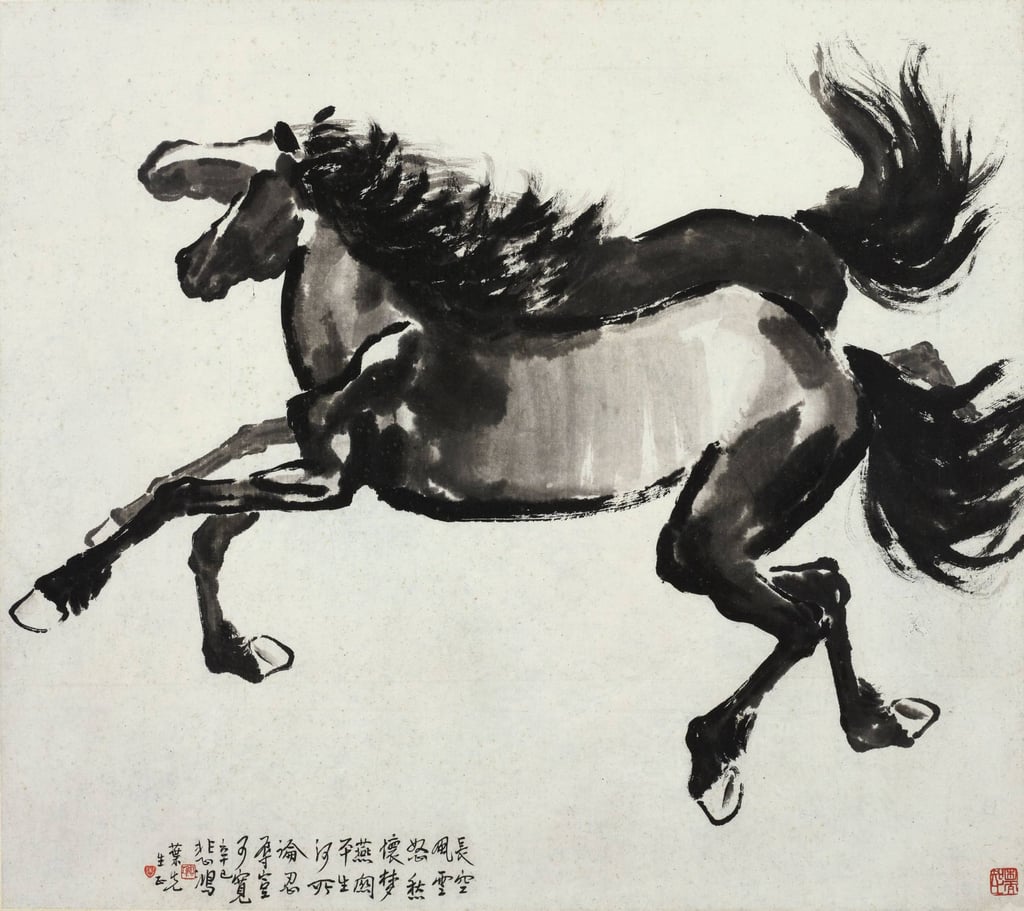
How Chinese artist Xu Beihong’s horse paintings have galloped through history
Known as the father of modern Chinese art and famed for his horse paintings, Xu Beihong blended Western techniques with Chinese tradition

In Chinese culture, horses often symbolise power, vitality and ambition. But in the eyes of Xu Beihong – the father of modern Chinese art, who was especially revered for his horse paintings – the strong animal represented something solemn, persistent and even tragic.
Xu was born in 1895, after the end of the first Sino-Japanese war, and he witnessed intense changes in China throughout his lifetime, including the end of imperial China, Japanese aggression, World War II and the rise of the Communist Party. His work, therefore, reflected the country’s turbulent transformation in the first half of the 20th century.
His early family life, too, was one of turmoil. He grew up in rural Yixing, in Jiangsu province, where he helped out on the family farm. His father, a teacher, taught him calligraphy from the age of six and Chinese painting from the age of nine.
During his teenage years, because of frequent flooding in his hometown, he often journeyed with his father to nearby counties, where they made a living by selling their paintings. Xu painted many naturalist subjects during this time.