Stephen Higgins is the head of race-day operations, tracks and racing facilities at the Hong Kong Jockey Club, whose main role is to ensure the smooth running of races at Sha Tin and Happy Valley.
Ahead of the final meeting of the season at Happy Valley on Wednesday, he spoke to Stephy Zhang about how he and his team guarantee a safe and optimal environment for thousands of racehorses, trainers and jockeys on race days.
In 2020, following Hong Kong’s first black rainstorm in three years, Stephen Higgins and his team ensured that Sunday racing at Sha Tin went ahead seamlessly despite almost 500mm of torrential rain.
Under normal conditions, the Sha Tin turf is regarded as one of the most stable surfaces in global racing, and at the heart of this high-stakes operation is Higgins and his 240-strong team of professionals.
Since joining the Hong Kong Jockey Club in 2017 as the head of race-day operations, tracks and racing facilities, Higgins has acted as the custodian of the tracks at both Sha Tin and Happy Valley, ensuring a safe and optimal environment for thousands of racehorses, trainers and jockeys.
But a lot of work goes into guaranteeing that Higgins can provide a “consistent going, safe and entertaining” race day.
Rise and shine
Higgins’ team start their race-day routine at 3am and he joins for the crucial track inspection, which begins at 7am.
Depending on the day, he walks the track at Sha Tin or Happy Valley alongside his tracks manager and a stipendiary steward to assess the surface for safety, evenness and firmness along a scale ranging from heavy to good to firm.
The team immediately deploys four specialised devices – a penetrometer, Clegg hammer, shear vane and going stick – to systematically record the turf’s exact condition, vertical strength and shear strength.
Hong Kong is currently the only racing jurisdiction to simultaneously use all four instruments with such precision, and racing fans can directly access updated penetrometer and Clegg hammer readings before the first race of every meeting.
Higgins’ early inspection determines the day’s watering strategy.
“We generally water on a race day, depending on the weather,” Higgins explained. “But ordinarily we’ll be assessing from a safety perspective and from a kindness to the horses’ perspective. It’s generally between five minutes and 10 minutes. If you divide the minutes by two, that gets the amount of millimetres of water that we’re going to put on the whole track.”
Home turf
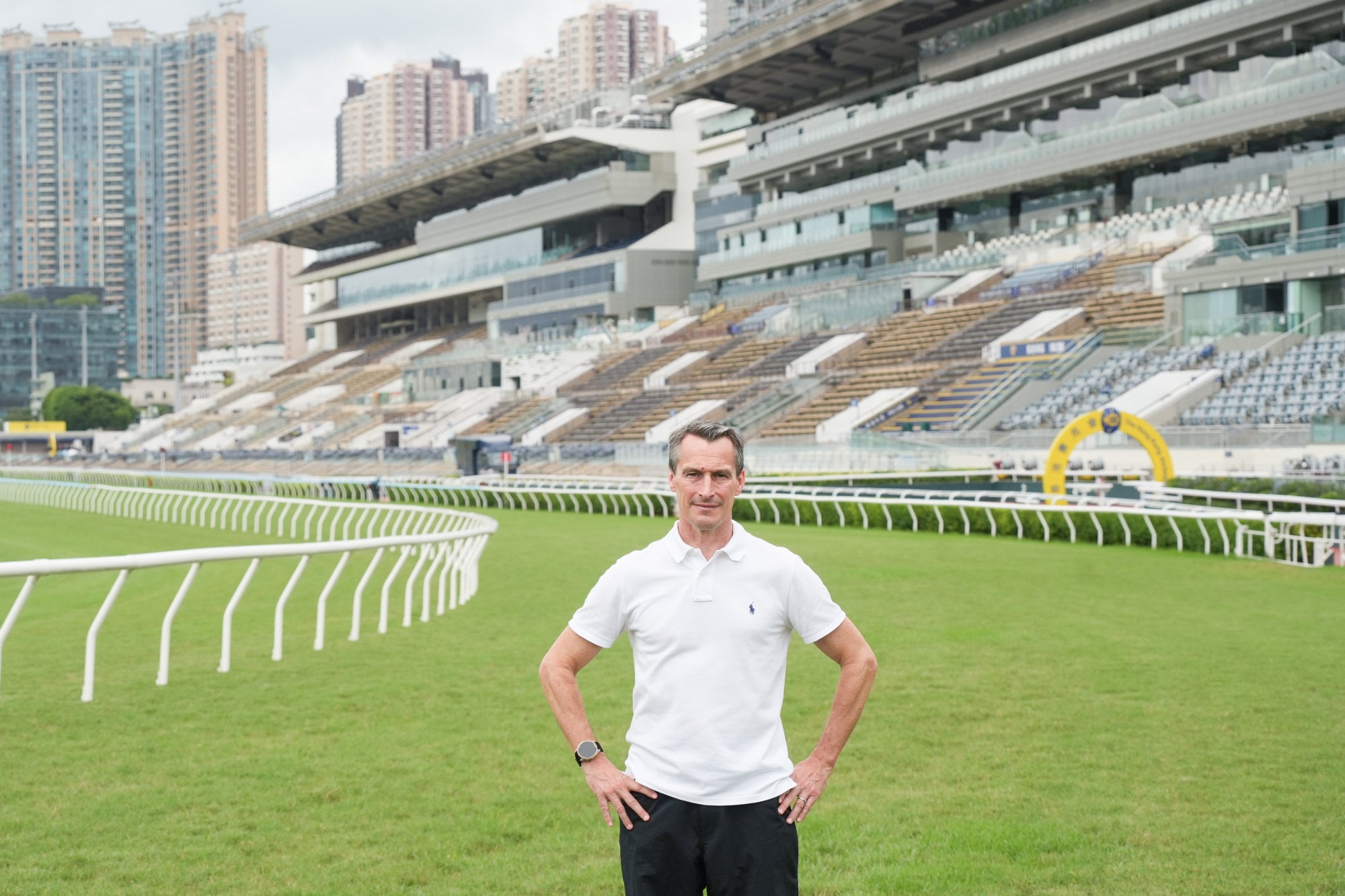
Managing the turf is a relentless agronomic challenge during Hong Kong’s gruelling 46-week season. The tracks rely on hybrid Bermuda grass, which thrives until late October.
As temperatures drop, Higgins’ team cuts the dormant Bermuda short and overseeds it with perennial ryegrass for the winter, reversing the process in April.
To keep the highly sensitive sand profile pristine, no organic material is allowed to remain on the surface; he said specialised mowers lift all grass clippings immediately rather than letting them mulch.
“So obviously the grass-cutter machinery is pretty important,” he noted.
The team also relies heavily on a Verti-drain machine, which uses finger-like blades to punch small holes into the ground to alleviate surface pressure and maintain the track’s crucial elasticity.
“[Regarding] the track’s performance, we can generally receive almost a thousand millimetres of rainfall an hour, and it pushes through the track and the track drains incredibly quickly,” he said. “It’s effectively designed like a golf course, or if you imagine a beach with grass.”
This meticulously managed profile consists of several layers of sand leading down to a perched water table below the turf. Water hits the racecourse, filters through the sand profile rapidly, hits the perched water and moves horizontally into the drainage ditches on the inside of the track to dissipate quickly.
“We had a black rainstorm at Happy Valley one race day, and I think it was black rain around about 5pm,” Higgins recalled, noting that precipitation reached intensities of 600 to 700mm an hour. “And the rainfall stopped around about 5.30pm. And by 7.15pm, we raced on that track.”

Military precision
Exactly two-and-a-half hours before the first race, the team returns to the track for a secondary round of measurements using the penetrometer, Clegg hammer and going stick.
Higgins reviews these figures against historical data from previous meetings to make a final assessment before officially calling the ground conditions.
Once the ground is declared, horses and personnel follow a strict countdown. During the races, Higgins is constantly on the move – from the weighing room to the parade ring and medical room – a familiar face across the complex.
“So under my control in terms of that race-day planning and timing to make sure everything runs to time, that is – I’m doing that,” he said.
Horses must arrive at the sand yard 25 minutes before their race before moving to the saddling boxes. Saddling takes roughly 10 minutes, and horses enter the parade ring exactly 15 minutes before post time.
Jockeys enter at the 14-minute mark to speak with owners and trainers, mounting between 11 and nine minutes pre-race. They must exit the parade ring by the eight-minute mark and arrive at the starting gates with three minutes to spare, where the starter organises them into their designated loading order before the gates open.
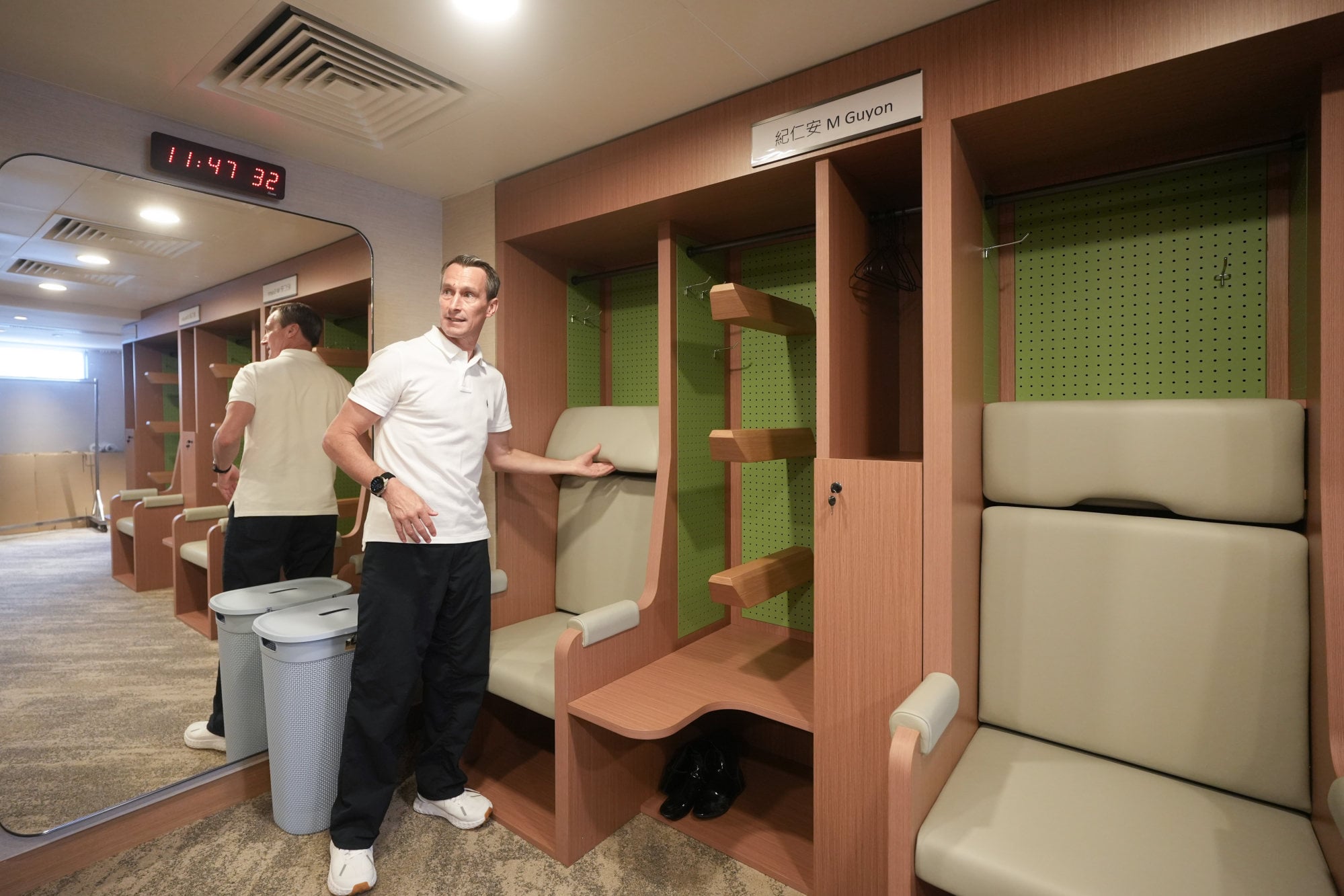
Meanwhile, a parallel race occurs inside the changing room, where a team of 12 valets manages equipment and silks. With only a 30-minute interval between races, logistics are intense.
This intricate countdown ticks continuously in Higgins’ mind.
When the gates open, he relocates from the parade ring to the eighth-floor stewards’ box at Sha Tin to watch the race alongside chief stipendiary steward Mark Van Gestel. While the stewards focus on policing jockey behaviour and enforcing racing rules, Higgins monitors the event from an infrastructure and safety perspective.
“My role at that point is to watch the race and look for any issues that might occur in terms of the track, track safety,” Higgins said. “If a horse comes into contact with the rail, then we’ll review the race after, we’ll go and check that position. If a horse may stumble, we might go and check the ground conditions to make sure that everybody’s comfortable, that there aren’t any issues.”
Although racing is inherently a high-risk sport, Higgins emphasises that rigorous preparation keeps incident rates remarkably low. Across a season featuring 864 races, major emergencies remain rare. However, vigilance is mandatory.
Higgins recalls a recent incident where jockey Harry Bentley suffered a fall on the back straight, resulting in a broken arm. His team immediately coordinated with the medical team to administer pain relief, determine whether hospital transport was required and contact Bentley’s family.
On any given race day, Higgins commands a chief medical officer, two doctors, four nurses and up to 12 St John Ambulance assistants and drivers, with two of their three on-site ambulances actively trailing the field during a race.
Beyond physical injuries, pre-race delays caused by difficult horses at the starting gates require immediate adjustments. If an on-site vet determines a horse is unfit to run, Higgins must instantly assess the operational impact.

In the entertainment business
Hong Kong’s volatile weather is the most frequent source of disruption to the racing schedule. However, Higgins notes that while rainfall simply alters track conditions from good to yielding, soft or heavy – which can actually increase safety by naturally slowing the horses down – thunderstorms pose an immediate danger.
“What we have seen more recently is during racing we get thunderstorms and we’ve become incredibly cautious, and we’re well informed in terms of how that might impact on the safety of the day,” he said.
Higgins monitors conditions using two independent digital networks. The first is an in-house weather station operating 365 days a year, tracking precipitation and wind speeds across four or five different tracking points on the course.
“And then we have this fairly sophisticated Strike Guard lightning protection system, and this is what’s measuring in real time the number of strikes that we’re getting within that distance,” he added, noting that the system tracks real-time strikes at distances of 2km, 4km and 10km.
“It doesn’t only tell you where the storm is and it’s occurring now – it’s predicting where that storm is going to be in 15 minutes, 30 minutes, 45 minutes,” Higgins explained.
This predictive tracking determines whether a storm will linger or pass. If a severe cell threatens the track, Higgins implements a 30-to-45-minute suspension, holding jockeys in the waiting room while the incident management team updates the public.
The Briton’s career trajectory explains his highly analytical approach to sports logistics.
A chartered surveyor by profession with a quantity surveying degree, his early career focused on major commercial property developments, including the redevelopment of Chelsea Football Club’s Stamford Bridge stadium in London.
However, having ridden horses and worked with racehorses since the age of 15, his passion for racing started at an early age. In his late 20s, he joined the UK Jockey Club, eventually managing 16 different racecourses across the country.
This focus on world-class infrastructure extends to human athletes as well. Under Higgins’ leadership, the club established and expanded the Jockeys’ Centre of Excellence.
The facility features a permanent race-day chef cooking tailored meals for each rider, hot and cold cryotherapy plunges, saunas, a specialised gym and a dedicated rest suite.
This elite support ensures Hong Kong remains an exceptionally attractive destination for top-tier international riding talent such as Zac Purton, James McDonald, Joao Moreira and Ryan Moore.
“When jockeys come from overseas, they see that set-up, they see that access, which they just don’t have access to in other racing jurisdictions,” Higgins stated.
As night falls on a race day and the crowds disperse, Higgins and his team enter a new cycle, reviewing the day’s races and preparing for the next meeting just days away. Yet, his definition of a successful day remains grounded in the core fundamentals of the sport.
“For me, a perfect racing day is sunshine, consistent going, safe and entertaining, because we’re in the entertainment business,” Higgins said.
“And that all the information that should be provided to our customer groups is delivered and that the owners, trainers, jockeys have an excellent day. If we can provide safe, compelling, entertaining racing that’s fair, then we’ve done a good job.”